
Updated: 16 October 2026, 6:30 PM IST
The e-Shram card is a free, Aadhaar-seeded identity card for unorganised workers aged 16 to 59, issued by the Ministry of Labour and Employment through the e-Shram portal. As of 18 August 2026, the portal had recorded 31.89 crore registrations, according to a PIB release marking its fifth anniversary.
Many workers still ask the same questions. Does the card pay money? Who can register? What happens after you get your Universal Account Number? This guide answers each one, step by step, using only official sources.
What Is the e-Shram Card?
e-Shram is the National Database of Unorganised Workers (NDUW). The Ministry of Labour and Employment launched it on 26 August 2021. Its purpose is simple: build one verified list of workers who have no formal employer benefits, so that welfare schemes can reach them faster.
Every worker who registers gets an e-Shram card with a 12-digit Universal Account Number (UAN). This number stays the same for life and works across states. As a result, a migrant construction worker from Bihar who moves to Gujarat does not need to register again.
However, it is important to be clear about one point. The e-Shram card is not itself a pension, an insurance policy or a cash transfer. The official e-Shram FAQ says that, right now, only registration is done through the portal. The card is a gateway: it makes it easier to enrol in schemes that do pay benefits.
e-Shram Card Benefits in 2026
The value of the e-Shram card comes from the schemes connected to it. According to the PIB note “5 Years of e-Shram Portal” (August 2026), the portal now works as a one-stop platform for welfare, jobs, skilling, apprenticeship and pension services.
Here are the main benefits a registered worker can access:
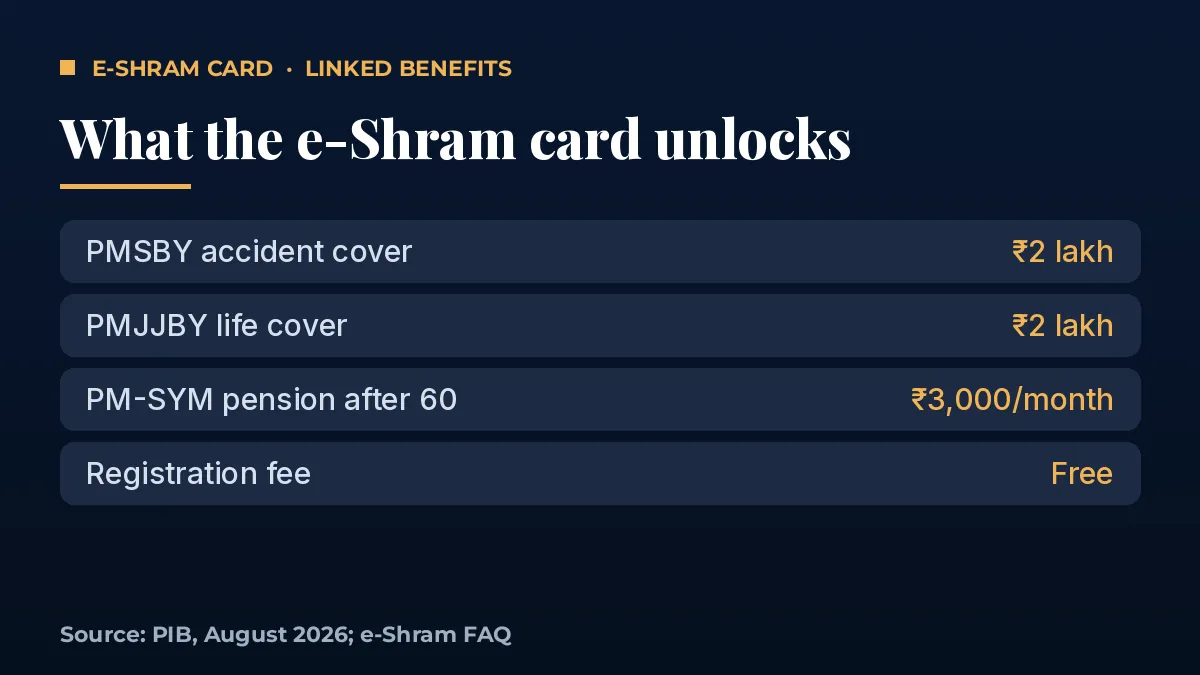
- Accident insurance (PMSBY): Registrants can enrol in Pradhan Mantri Suraksha Bima Yojana through the portal. It pays ₹2 lakh for accidental death or permanent disability and ₹1 lakh for partial disability. The premium is ₹20 a year.
- Life insurance (PMJJBY): Pradhan Mantri Jeevan Jyoti Bima Yojana gives ₹2 lakh cover for death due to any cause, for a premium of ₹436 a year.
- Pension (PM-SYM): Workers aged 18 to 40 can join Pradhan Mantri Shram Yogi Maan-dhan, which promises ₹3,000 a month after age 60, with the Centre matching the worker’s contribution.
- Ration portability: e-Shram data is linked with One Nation One Ration Card (ONORC), so eligible families can draw ration anywhere in India.
- Jobs and skills: Registrants can search for jobs, apprenticeships and skilling options through linked national portals.
- Targeted help in emergencies: The FAQ notes that the database may be used to deliver assistance during a national crisis, as happened during COVID-19.
Who Can Apply: Eligibility for Unorganised Workers
The rules for e-Shram registration are short. According to the e-Shram FAQ and the PIB release, a worker must meet all of these conditions:
- Age: between 16 and 59 years.
- Work: engaged in the unorganised sector. This includes home-based workers, self-employed workers and wage workers with no formal social security.
- Not an EPFO or ESIC member: anyone whose employer deducts PF or ESI is already in the organised sector.
- Not an income-tax payer.
- Not a government employee.
Typical unorganised workers include farm labourers, construction workers, domestic workers, street vendors, gig and platform workers, rickshaw pullers, fishers, beedi workers, ASHA and Anganwadi workers, and small shopkeepers. Students aged 16 or more can also register if they meet the other criteria, as the FAQ confirms.
That said, eligibility for the card does not mean automatic eligibility for every linked scheme. For example, PM-SYM has its own age limit (18 to 40) and an income ceiling of ₹15,000 a month. Always check each scheme’s rules separately.
Documents Needed for e-Shram Registration
The document list is short, and that is one reason registrations have grown so quickly. You need:
- Aadhaar number for e-KYC (OTP or biometric).
- Mobile number, preferably linked to Aadhaar, for OTP-based self-registration.
- Bank account details (account number and IFSC), so that any future benefit can be credited directly.
- Basic details: occupation, education, address and nominee name.
If your mobile number is not linked to Aadhaar, you can still register. In that case, visit a Common Service Centre (CSC) or a State Seva Kendra, where the operator uses biometric authentication instead.
How to Apply for the e-Shram Card Online: 5 Steps
Registration is free. No agent, CSC or website is allowed to charge you for it. Follow these steps on the official portal:
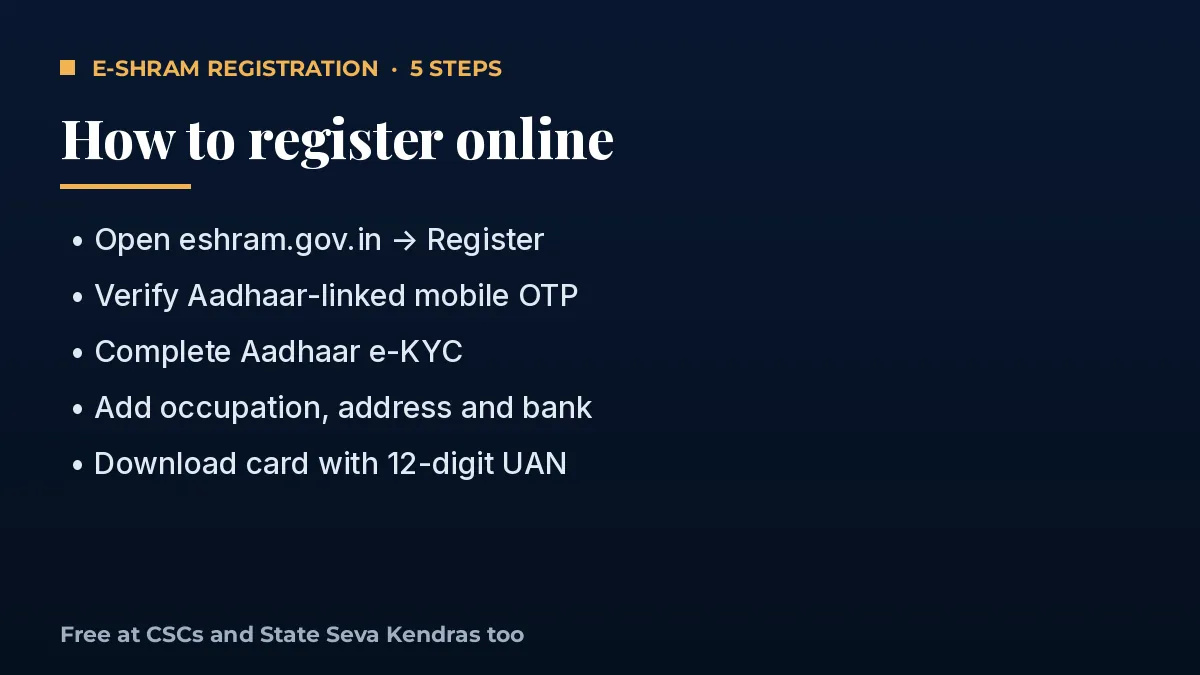
- Open the portal: go to eshram.gov.in and choose “Register on e-Shram”.
- Verify your mobile: enter your Aadhaar-linked mobile number, fill the captcha and answer the EPFO/ESIC question honestly. Then enter the OTP.
- Complete Aadhaar e-KYC: enter your Aadhaar number and the OTP sent by UIDAI. Your name, photo and address are fetched automatically.
- Fill in your details: add address, education, occupation, skills and bank account. Choose your main occupation from the list carefully, because schemes are often targeted by occupation.
- Download the card: submit the form and download your e-Shram card with its Universal Account Number as a PDF. Keep a printed copy.
Prefer offline help? Visit your nearest CSC or State Seva Kendra with your Aadhaar card, mobile phone and bank passbook. Government field officers also organise registration camps at district and block level.
What Happens After You Get Your Universal Account Number
Once you hold an e-Shram card, the next step is to use it. Because the card does not pay money on its own, the real gains come from enrolling in linked schemes.
First, log in to the portal and check the scheme section. Here, you can enrol in PMSBY and PMJJBY directly, according to PIB. Second, if you are between 18 and 40, consider PM-SYM. A worker who joins at 29 pays ₹100 a month, and the government adds an equal amount. Third, keep your profile updated. If you change your mobile number, bank account, address or occupation, update it on the portal so benefits are not held up.
In short, think of the e-Shram card as your entry ticket. It proves who you are and what work you do. The insurance, pension and ration benefits come through the schemes you join next.
e-Shram Card Numbers: Who Has Registered So Far
The fifth-anniversary data from PIB (as on 20 August 2026) shows who is using the platform:
| Indicator | Value |
|---|---|
| Total registrations | 31.89 crore |
| Women among registrants | 54.28% |
| Men among registrants | 45.72% |
| Aged 18–40 | 55.21% |
| Aged 40–50 | 24.18% |
| Above 50 | 20.53% |
Two things stand out. First, women make up more than half of all e-Shram card holders. Second, most registrants are young or middle-aged, which matters for long-term schemes like PM-SYM, where joining early means a smaller monthly contribution.
Five Insights Before You Register
- It is free, always. Anyone asking for money to make an e-Shram card is breaking the rules. Report such cases to the helpline.
- One worker, one UAN. Do not register twice. Duplicate registrations can delay benefits.
- Be honest about EPFO and ESIC. If you later join a formal job with PF, your status changes. Update the portal rather than hiding it.
- Link a working bank account. DBT payments fail when the account is closed or not Aadhaar-seeded.
- Insurance needs a separate step. Registration alone does not make you insured. You must enrol in PMSBY or PMJJBY and keep the auto-debit active.
What Happens Next
The e-Shram portal keeps adding services. PIB describes it as moving from a database to a single platform for welfare, jobs, skilling and pensions. For workers, the practical advice is clear: get the e-Shram card now, then enrol in the insurance and pension schemes you qualify for.
If you already have the card, log in once to check that your mobile number, bank details and occupation are correct. Small errors are the most common reason a benefit does not reach the right account.
For related schemes, see our guides on Atal Pension Yojana for retirement income, the PM Vishwakarma loan and toolkit scheme for artisans, the Ayushman Bharat card for citizens aged 70 and above, and PM Awas Yojana Gramin housing support.
Frequently Asked Questions
Does the e-Shram card give ₹1,000 or ₹3,000 every month?
No. The official e-Shram FAQ says there is no direct cash benefit from registration itself. The ₹3,000 monthly figure belongs to PM-SYM, a separate pension scheme that pays only after age 60 to members who contribute regularly. Some states have paid one-time help to registrants, but that is not a national monthly payment.
Who is not eligible for the e-Shram card?
You cannot register if you are an EPFO or ESIC member, an income-tax payer or a government employee. You must also be between 16 and 59 years old. Everyone else working in the unorganised sector, including gig workers, domestic workers and small farmers, can register free of cost.
How do I download my e-Shram card again?
Go to eshram.gov.in, choose the option to log in or update your profile, and verify with your Aadhaar-linked mobile OTP. After login, you can view and download the e-Shram card PDF with your Universal Account Number. If OTP fails, a CSC can help using biometric login.
Is there any fee for e-Shram registration?
No. Registration is completely free, as both the portal and the National Informatics Centre state clearly. Neither the worker nor the CSC operator has to pay. If anyone demands money, do not pay, and report it through the official e-Shram helpline listed on the portal.
Can gig and platform workers get an e-Shram card?
Yes. Delivery partners, cab drivers and other platform workers who are not EPFO or ESIC members can register as unorganised workers. Registration also helps them enrol in PMSBY and PMJJBY through the portal, giving accident and life cover at a low annual premium.
Sources
- PIB: e-Shram Portal completes five years (August 2026)
- e-Shram official FAQs
- National Informatics Centre: e-Shram registration
- Ministry of Labour and Employment
How we verified: every figure in this article comes from the PIB release of August 2026, the e-Shram FAQ page and NIC’s service note, checked on 16 October 2026.
Disclaimer: JanSarkariYojna.com is an independent information website and is not connected with any government department. Rules can change; confirm details on eshram.gov.in before you apply.