


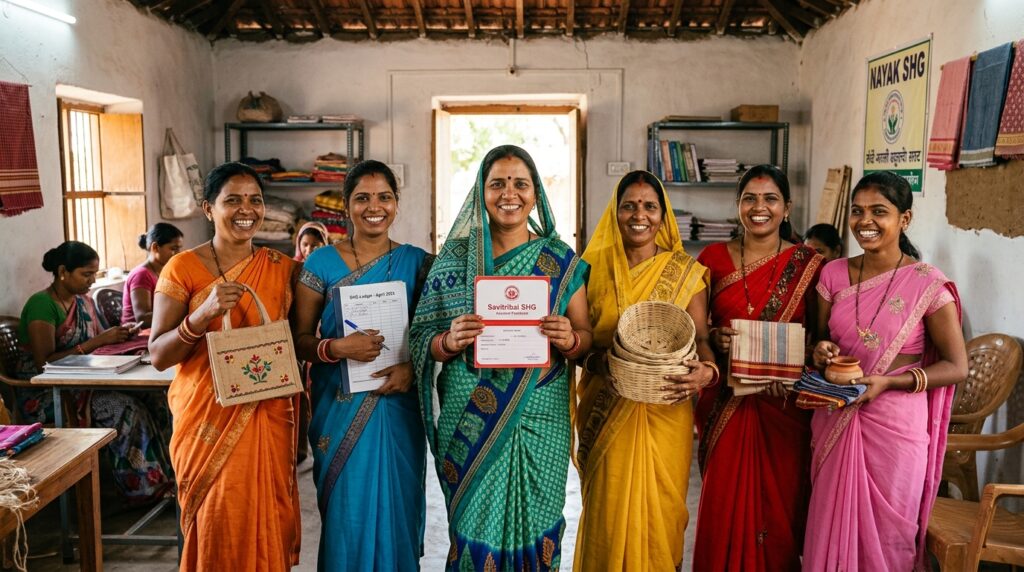
In a historic move to accelerate economic sovereignty across rural India, the Central Government transformed community-led development through the expanded rollout of the Lakhpati Didi Yojana under the Ministry of Rural Development (MoRD) and Deendayal Antyodaya Yojana – National Rural Livelihoods Mission (DAY-NRLM). Recognizing that sustainable poverty eradication requires transitioning from subsistence livelihoods to structured rural micro-enterprises, Prime Minister Narendra Modi established an ambitious national directive to create 3 crore (30 million) Lakhpati Didis across India. This nationwide mission provides rural women in Self-Help Groups (SHGs) with multi-dimensional enterprise support, spanning financial planning, collateral-free institutional credit, advanced technical training, digital technology tools, and direct market access.
Historically, rural women participating in village self-help groups relied primarily on small internal loans to handle family emergencies or subsistence agricultural expenses. Under the modernized Lakhpati Didi framework, the government integrates institutional credit architecture with specialized vocational skills—ranging from agri-tech drone piloting and solar installation to high-value food processing and commercial textile production. This comprehensive citizen manual explains the exact qualifying benchmarks, the four pillars of financial empowerment, eligible trade clusters, bank loan procedures, and how self-help group members can access scheme benefits through official government channels.
Defining a Lakhpati Didi: Official Criteria and Earning Benchmarks
Understanding what constitutes a certified beneficiary under government guidelines ensures transparency and focused livelihood tracking:
- Sustainable Annual Income Benchmark: A Lakhpati Didi is officially defined as a rural Self-Help Group woman member whose household realizes a sustainable annual income of at least ₹1,00,000 (₹1 Lakh) or more, with earnings sustained over at least four consecutive seasons or financial quarters.
- Monthly Earning Threshold: The benchmark translates to an average net income of ₹10,000 or more per month, derived from productive economic activities after deducting operating costs and loan repayments.
- Livelihood Diversification Requirement: To ensure financial resilience against unpredictable crop failures or localized economic downturns, each member is encouraged to adopt at least two distinct income streams across agriculture, livestock rearing, rural manufacturing, or modern retail services.
- SHG Institutional Standing: The beneficiary must belong to an active Self-Help Group that maintains regular weekly meetings, continuous internal savings, timely repayment cycles, and updated accounting ledgers.
Core Support Architecture: Four Pillars of Lakhpati Didi Empowerment
The operational framework of the scheme rests upon four integrated support mechanisms designed to eliminate common bottlenecks encountered by rural women entrepreneurs:
1. Capital Infusion and Seed Funds
Each newly formed or active SHG receives a Revolving Fund (RF) of ₹20,000 to ₹30,000 to stimulate internal micro-lending. As groups mature, they access the Community Investment Support Fund (CIF) providing up to ₹1.50 Lakh per group, channeled through Village Organizations (VOs) to finance member enterprise capital requirements.
2. Subsidized Collateral-Free Institutional Credit
Under revised RBI and DAY-NRLM credit linkage guidelines, women self-help groups can secure collateral-free commercial bank loans up to ₹10 Lakh without pledging personal assets or third-party guarantees. For individual enterprise expansion, eligible women can access dedicated enterprise loans up to ₹5 Lakh backed by the Credit Guarantee Fund for Micro Units (CGFMU), featuring central interest subvention subsidies that reduce effective interest rates to 7% per annum or lower.
3. Vocational Certification and Technological Upgradation
Members receive certified skill training through Rural Self Employment Training Institutes (RSETIs), Krishi Vigyan Kendras (KVKs), and National Skill Development Corporation (NSDC) hubs. Training extends beyond basic handicrafts to high-value technical sectors including computerized accounting, commercial poultry management, food safety standards, and agricultural machinery maintenance.
4. Direct Market Linkages and Digital Commerce
To eliminate exploitative local middlemen, the Ministry of Rural Development facilitates direct procurement access. Lakhpati Didi enterprises are onboarded onto the Government e-Marketplace (GeM) and Open Network for Digital Commerce (ONDC), alongside dedicated exhibition stalls at national SARAS Melas and regional craft exhibitions across Indian metropolitan centers.
Comparative Analysis: Traditional SHG Financing vs. Lakhpati Didi Framework
The strategic shift from basic micro-savings to structured enterprise scaling is illustrated in the operational comparison below:
| Parameter | Traditional SHG Financing | Lakhpati Didi Enterprise Framework |
|---|---|---|
| Primary Objective | Consumption smoothing and emergency household relief | Sustainable wealth creation of more than ₹1 Lakh annual net income |
| Credit Upper Limit | ₹50,000 to ₹1,00,000 internal group loans | ₹5 Lakh individual / ₹10 Lakh collateral-free group bank loans |
| Interest Rate Mechanism | Standard commercial MFI rates (12% to 18%) | Interest subvention reducing net borrowing rate to 7% or below |
| Training Scope | Informal peer-to-peer knowledge sharing | Certified institutional courses via RSETIs, KVKs, and NSDC |
| Technology Adoption | Manual record books and traditional tools | Digital LokOS app, AePS banking, and agri-tech drone operation |
| Market Access Channels | Localized village markets and weekly haats | Government e-Marketplace (GeM), ONDC, and SARAS national fairs |
High-Income Trade Clusters Covered Under the Scheme
The program supports diverse vocational clusters categorized into three broad enterprise domains:
Agriculture and Allied Farm Enterprises
- Commercial Horticulture & Polyhouse Farming: Cultivation of high-value off-season vegetables, strawberries, exotic herbs, and floriculture with drip irrigation support.
- Dairy & Goat Husbandry Value Chains: Cooperative milk collection points, bulk milk chilling unit linkages, organized goat breeding clusters, and fodder processing units.
- Organic Bio-Inputs & Vermicomposting: Production and marketing of certified organic fertilizers, vermicompost beds, and bio-pesticides sold directly to regional farming clusters.
- Apiculture and Honey Extraction: Scientific bee-keeping, honey extraction, filtration, and branded consumer packaging.
Non-Farm Rural Manufacturing and Craftsmanship
- Food Processing and Preservation: Hygienic packaging of indigenous spices, traditional pickles, cold-pressed mustard and sesame oils, and value-added millet products (ragi flour, millet snacks).
- Textiles, Handlooms & Apparel: Ready-made garment manufacturing, school uniform contracts, traditional handloom weaving, embroidery, and natural-dye textile printing.
- Eco-Friendly Packaging Products: Biodegradable paper bags, jute packaging containers, leaf plates (areca nut and sal leaves), and non-plastic household consumables.
Modern Service Delivery and Technology Roles (Didi Specializations)
One of the most transformative elements of the Lakhpati Didi initiative is the introduction of specialized technology roles:
- Namo Drone Didi: Selected women receive 15 days of certified drone pilot training at authorized aviation training academies. Equipped with specialized agricultural drones provided through 80% central subsidies, they provide automated liquid fertilizer (Nano Urea) and pesticide spraying services to farmers, earning steady monthly service revenues exceeding ₹15,000.
- Bank Sakhi (Digi-Pay Sakhi): Certified women operating portable micro-ATMs and biometric fingerprint scanners deliver doorstep banking services, pensions, and DBT cash withdrawals in unbanked rural hamlets, earning recurring commission per transaction.
- Krishi Sakhi & Pashu Sakhi: Village-level master trainers trained in organic crop cultivation and veterinary first-aid who advise farmers on soil health cards, cattle vaccination, and artificial insemination.
Eligibility Criteria for Lakhpati Didi Scheme Enrollment
To participate in enterprise training and credit linkage under the scheme, candidates must fulfill clear parameters:
- Residency: The applicant must be a female resident Indian citizen living in a rural or peri-urban gram panchayat area.
- SHG Membership: Active membership in a Women Self-Help Group (WSHG) registered with the State Rural Livelihoods Mission (SRLM) for a minimum duration of 6 months.
- Panchasutra Adherence: Demonstrated track record of regular weekly group meetings, regular internal thrift savings, internal inter-loaning, timely repayment of loans, and maintained books of accounts.
- Aadhaar-Linked Bank Account: Possession of a verified individual savings bank account with active Aadhaar and NPCI mapping for direct benefit transfers.
- Micro-Investment Plan (MIP): Willingness to draft a comprehensive household livelihood and business plan with technical guidance from community resource persons (CRPs).
Step-by-Step Registration and Implementation Workflow
Enrollment into the Lakhpati Didi ecosystem follows a structured institutional path through village community networks:
Step 1: Household Livelihood Assessment and Micro-Plan Formulation
The SHG member, assisted by a Community Resource Person (CRP-EP) or Krishi Sakhi, conducts an audit of existing family assets, landholdings, skills, and seasonal cash flows. Together, they formulate a detailed Micro-Investment Plan (MIP) identifying viable trade activities and required capital investment.
Step 2: Village Organization (VO) Scrutiny and Endorsement
The completed Micro-Investment Plan is presented at the monthly meeting of the Village Organization (the federation of 10 to 20 SHGs). The VO evaluates the financial feasibility, confirms member creditworthiness, and endorses the credit request.
Step 3: Registration on the DAY-NRLM LokOS Digital Portal
The endorsed profile and enterprise data are uploaded into the official government tracking database on nrlm.gov.in using the LokOS mobile application. This assigns the member a unique national beneficiary identifier for monitoring income progression.
Step 4: Institutional Training at RSETI or Training Centers
Based on the chosen economic activity, the member is enrolled in a 10 to 30 day intensive residential or non-residential skill development module at the district Rural Self Employment Training Institute (RSETI) or authorized vocational center at zero tuition fee.
Step 5: Bank Credit Linkage and Asset Procurement
Upon training completion, the lending commercial bank or regional rural bank (RRB) sanctions the approved enterprise loan tranche. Capital is utilized to purchase certified machinery, livestock, irrigation equipment, or raw material stock.
Step 6: Ongoing Mentorship and Direct Market Linkage
Community mentors monitor enterprise cash flow on a quarterly basis. Beneficiary products are branded under regional SHG banners and integrated into government procurement pipelines, district retail emporiums, and e-commerce portals.
Convergence with Other Central Government Welfare Missions
The Lakhpati Didi initiative does not operate in isolation; it integrates directly with key central welfare programs to provide a holistic financial safety net for rural families. Women expanding independent fabrication or workshop trades benefit from collateral-free machinery financing and tool vouchers under the PM Vishwakarma Yojana. Furthermore, adopting clean rooftop solar electricity through the PM Surya Ghar Muft Bijli Yojana slashes workshop utility overheads, while universal family health coverage under the Ayushman Bharat 70 Plus Senior Citizen Card shields household business capital from being wiped out by sudden medical emergencies.
For rural households seeking permanent residential construction, synchronizing enterprise gains with pucca housing grants under PMAY Urban 2.0 or rural housing missions establishes generational financial resilience and asset ownership in the name of the female head of the family.
Grievance Redressal Mechanisms and Official Helplines
If self-help group members face procedural roadblocks, arbitrary bank loan rejections, or delays in training sponsorship, established administrative channels provide resolution:
- DAY-NRLM Official National Portal: Access national guidelines and circulars online at
nrlm.gov.inor the central Ministry of Rural Development portal atrural.gov.in. - Block & District Mission Management Units (BMMU / DMMU): Every block development office features a dedicated NRLM Block Mission Manager tasked with redressing SHG grievances within 15 working days.
- State Rural Livelihoods Mission (SRLM) Helplines: Each state administration operates a centralized toll-free call center for rural women entrepreneurs to report bank non-cooperation or subsidy delay issues.
- Banking Ombudsman: If an empaneled commercial bank unlawfully demands collateral for SHG loans below statutory limits, complaints can be lodged directly on the Reserve Bank of India CMS portal at
cms.rbi.org.in.
Frequently Asked Questions (FAQ)
Can an individual woman who is not an SHG member apply directly for Lakhpati Didi?
No. Scheme benefits are routed exclusively through the Self-Help Group institutional mechanism. An interested woman must join an existing local Women SHG or form a new 10 to 15 member group under the guidance of her local gram panchayat and Block Mission Management Unit.
Is the financial support under Lakhpati Didi a complete grant or a loan?
The scheme incorporates both grants and credit. Skill development training, mentorship, and seed revolving funds are 100% government-funded grants. Enterprise expansion capital is provided as subsidized, collateral-free bank credit that must be repaid according to the agreed installment schedule.
What is the interest rate charged on bank loans under this program?
Under the DAY-NRLM interest subvention scheme, prompt-repaying women self-help groups receive central subsidies reducing the effective interest rate to 7% per annum on credit amounts up to ₹3,00,000, with further state-level subventions in several participating states lowering effective rates even further.
How does the Namo Drone Didi training work?
Eligible women members identified by cluster level federations undergo 15 days of intensive drone piloting, calibration, and safety protocols conducted by Directorate General of Civil Aviation (DGCA) certified instructors. Successful graduates receive commercial drone pilot certification and an advanced agricultural drone kit.
Where can citizens download the official Lakhpati Didi tracking app?
Field tracking and member performance updates are recorded via the official LokOS and DAY-NRLM mobile applications accessible to authorized Community Resource Persons (CRPs) on the Google Play Store and through nrlm.gov.in.
Disclaimer: JanSarkariYojna.com is an independent public-information platform. We are not affiliated with any government ministry or agency. Verify all scheme guidelines on the respective official government portal (.gov.in / .nic.in).