


Updated: 17 October 2026, 9:30 AM IST
The PM Fasal Bima Yojana (PMFBY) lets farmers insure Rabi crops such as wheat, gram, mustard and barley for a premium of just 1.5% of the sum insured, with the Centre and states paying the rest. Rabi 2026-27 enrolment is now open in most states, and the cut-off generally falls on 31 December 2026, according to the Ministry of Agriculture and Farmers Welfare.
This matters more than usual this year. The RBI’s October 2026 policy statement flagged a deficient south-west monsoon and strong El Niño conditions as risks to farm output. So how much will you pay, what is covered, and how do you apply before the deadline? This guide answers each question using official sources only.
Table of Contents
What Is the Pradhan Mantri Fasal Bima Yojana?
Pradhan Mantri Fasal Bima Yojana is the Government of India’s flagship crop insurance scheme. It started in the 2016 Kharif season and replaced older schemes such as NAIS and MNAIS. The Department of Agriculture and Farmers Welfare runs it with state governments, which select insurance companies through bidding.
The idea is simple. A farmer pays a small, fixed share of the premium. The rest of the actuarial premium is shared between the Centre and the state, generally 50:50, and 90:10 in the north-eastern states. As a result, the farmer’s cost stays low even when the real insurance cost is high.
Claims are paid directly into the farmer’s bank account. Enrolment, premium and claim data all sit on the National Crop Insurance Portal (NCIP) at pmfby.gov.in, so a farmer can track an application online.
PM Fasal Bima Yojana Rabi 2026-27: Premium Rates
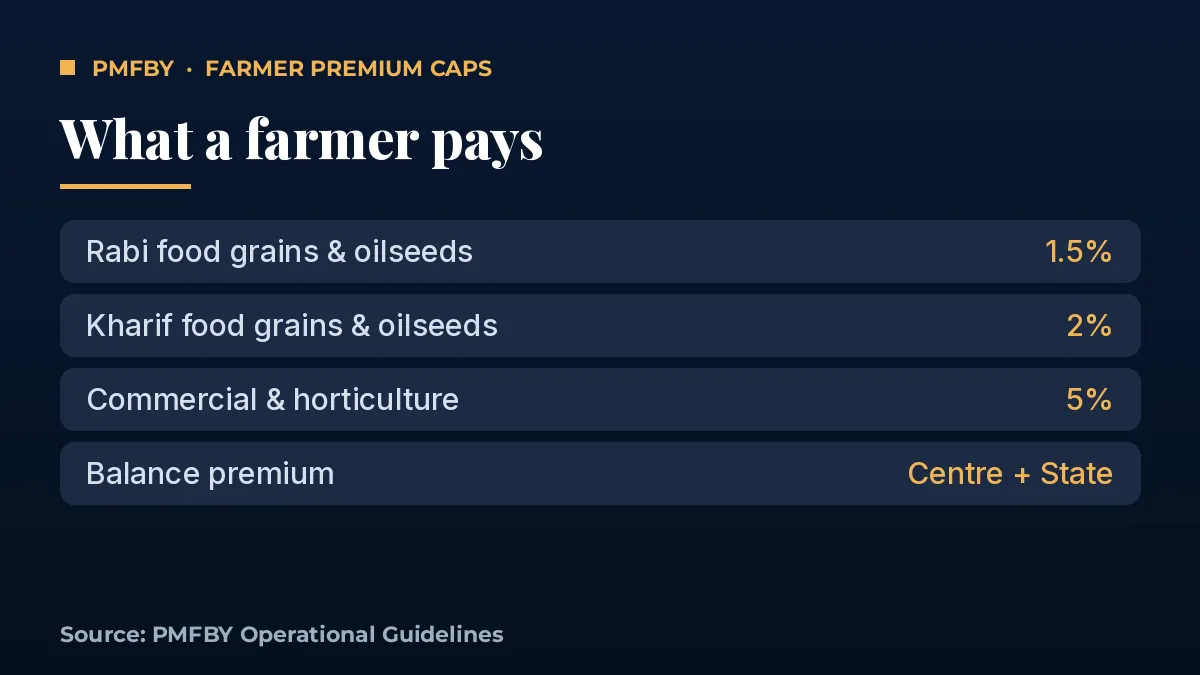
The farmer’s share of premium is capped by season and crop type. These caps come from the PMFBY Operational Guidelines and are repeated in state tender documents for Rabi 2026-27.
| Season | Crops | Maximum farmer premium |
|---|---|---|
| Rabi | Cereals, millets, pulses and oilseeds (wheat, gram, mustard, barley, lentil) | 1.5% of sum insured |
| Kharif | Cereals, millets, pulses and oilseeds | 2% of sum insured |
| Kharif and Rabi | Annual commercial and horticultural crops | 5% of sum insured |
In each case, the farmer pays the capped rate or the actuarial rate, whichever is lower. For example, if the sum insured for wheat on one hectare is ₹60,000, the farmer pays at most ₹900. The government pays the balance, however large it is.

The sum insured is not a number you choose. It equals the Scale of Finance fixed by the District Level Technical Committee for that crop, multiplied by the insured area. In short, it reflects what it costs to grow the crop in your district.
Who Can Enrol in the Scheme?
All farmers who grow a notified crop in a notified area can join. That includes owner-cultivators, tenant farmers and sharecroppers. Tenants and sharecroppers must show proof of their tenancy or sharecropping arrangement as notified by the state.
- Loanee farmers: Farmers with a crop loan or Kisan Credit Card are enrolled through their bank. Since the 2020 revamp, enrolment is voluntary, so a loanee farmer who does not want cover must submit an opt-out declaration before the date the state notifies.
- Non-loanee farmers: Farmers without a crop loan can apply on their own through the portal, a Common Service Centre (CSC), a bank branch or an insurance company’s agent.
- Notified crops only: Each state publishes a list of crops and areas covered for the season. If your crop is not notified in your village or block, you cannot insure it under PMFBY that season.
The PIB statement of 2 December 2025 adds an important warning. Applications are checked for insurable interest, land ownership or tenancy proof, and whether the insured area matches the actual land parcel. The name must also match Aadhaar. Wrong or incomplete details can lead the insurer to reject the application.
What Risks Does PM Fasal Bima Yojana Cover?
Under the PM Fasal Bima Yojana, cover runs across the crop cycle. The Operational Guidelines list four stages:
- Prevented sowing: If deficit rainfall or adverse weather stops sowing across the insured area, a claim can be paid.
- Standing crop: Yield losses from drought, dry spells, flood, inundation, pests and diseases, landslides, natural fire, lightning, storms, hailstorms and cyclones are covered.
- Post-harvest losses: Crops left to dry in the field in “cut and spread” condition are covered for up to two weeks from harvest against cyclone, cyclonic rain and unseasonal rain.
- Localised calamities: Damage to individual farms from hailstorm, landslide and inundation is assessed farm by farm.
On the other hand, losses from war, nuclear risks, malicious damage and other preventable risks are excluded.
Rabi 2026-27 Last Date and Key Timelines
There is no single national deadline. The central guidelines give an indicative Rabi window, but each state’s notification for its crops is final. According to the PIB reply in Lok Sabha, the cut-off for premium debit and enrolment “generally is 31st July for Kharif season and 31st Dec for Rabi season”.
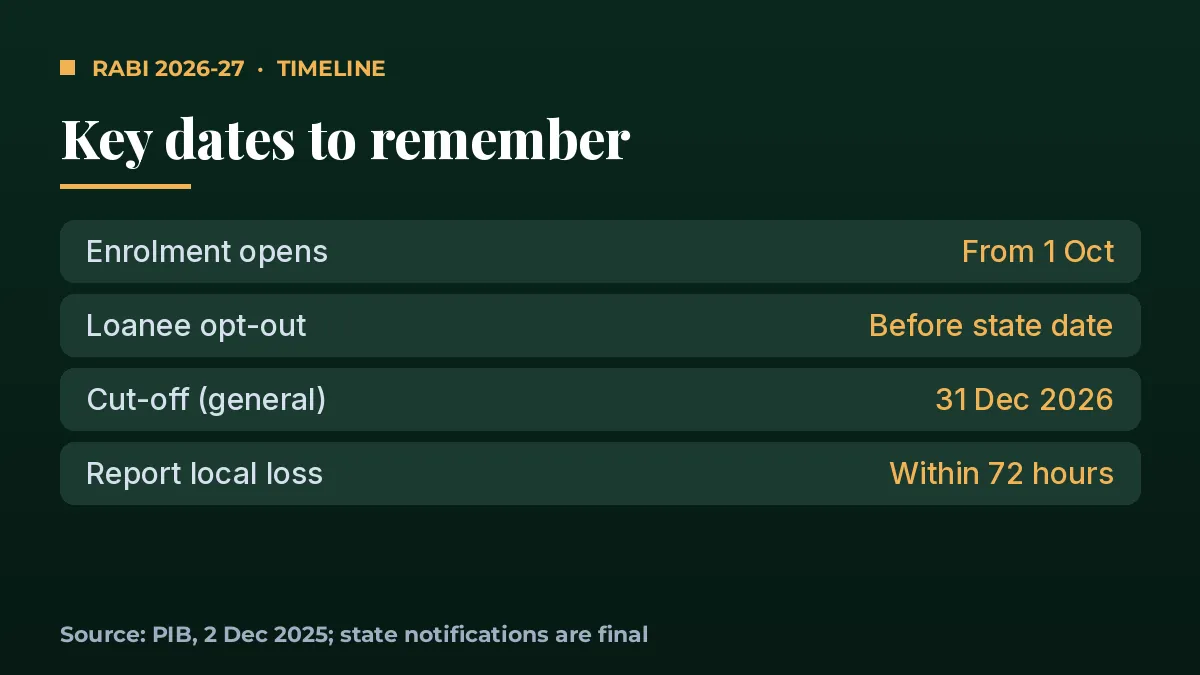
In practice, Rabi enrolment in most states opens from 1 October. Loanee farmers usually get a separate, earlier date to opt out, and some states also allow a change of insured crop a few days before the final cut-off. Because these dates differ by state and crop, always check your state’s Rabi 2026-27 notification on pmfby.gov.in or at your bank branch.
Do not wait for the last week, though. Portal and CSC queues get long near the cut-off, and insurers can reject applications with missing documents. Moreover, the scheme’s rules say that states which extend cut-off dates on their own lose central premium subsidy for those crops, so extensions are rare.
Documents Needed for Crop Insurance
Keep these ready before you visit a CSC or apply online:
- Aadhaar card (the name on the application must match Aadhaar)
- Bank passbook or account details for an Aadhaar-seeded account
- Land record: khasra/khatauni, Record of Rights or the state’s land document
- Sowing declaration or certificate for the crop and area sown, where the state asks for it
- Tenancy or sharecropping agreement or certificate, for tenant farmers
- Mobile number for OTP and SMS updates
How to Apply for PM Fasal Bima Yojana Online
Non-loanee farmers can apply for the PM Fasal Bima Yojana in a few steps on the National Crop Insurance Portal:
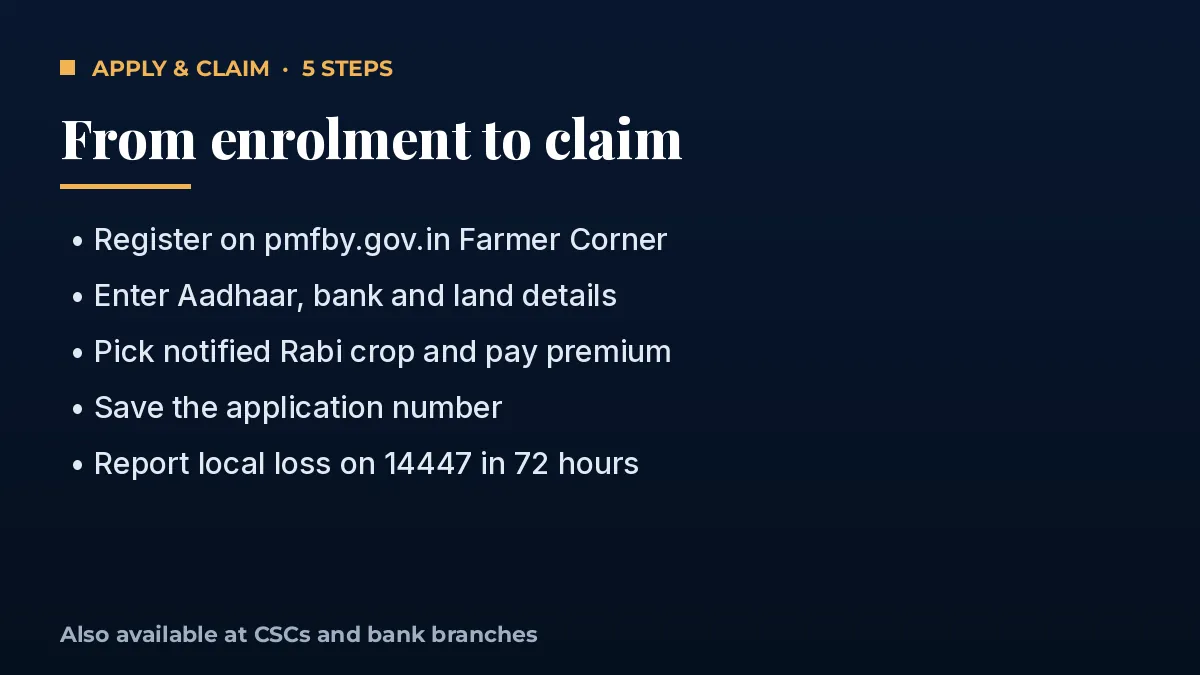
- Open pmfby.gov.in and go to Farmer Corner.
- Choose “Apply for Crop Insurance yourself” and register as a guest farmer with your mobile number and OTP.
- Enter personal, bank and residential details exactly as in Aadhaar and your passbook.
- Select season (Rabi), year (2026), scheme (PMFBY), state, district and the land parcel, then choose the notified crop and area sown.
- Upload the land record and sowing document, check the premium shown, and pay online.
- Save the application number. You can check status later under “Application Status”.
Alternatively, visit a CSC or your bank branch, where staff enrol you on the same portal. Insurers and intermediaries also enrol farmers. Wherever you apply, insist on a receipt with the application number.
How to Report a Crop Loss and Get a Claim
For widespread losses such as drought or a district-wide yield fall, claims are calculated from crop-cutting experiments and yield data. You do not need to file a separate claim in that case.
For localised calamities and post-harvest losses, the farmer must report the loss within 72 hours. You can call the Krishi Rakshak Portal and Helpline on the toll-free number 14447, use the Crop Insurance app, or inform your bank, the insurance company or the local agriculture office. According to PIB, the helpline runs 24×7 through more than 500 executives across 10 locations.
If an application is rejected or a claim is disputed, raise a grievance on the Krishi Rakshak portal first. After that, you can approach the District Grievance Redressal Committee, and then the State Grievance Redressal Committee.
Five Insights Before You Enrol
- The 1.5% cap is your biggest gain. The true actuarial cost can be several times higher; the government absorbs the gap.
- Match your land data. Insured area larger than your actual parcel is a common reason for rejection.
- Loanee farmers should check their bank statement. If the premium was debited, you are covered; ask the branch for your policy details.
- Report fast. The 72-hour window for localised losses is strict, so save 14447 in your phone now.
- Pair cover with other support. Crop insurance protects yield, not price, so also check state schemes on our state government schemes page.
What Happens Next
Over the next ten weeks, states will close Rabi enrolment crop by crop. A weak monsoon and El Niño can raise the chance of dry-spell and yield losses this season, which is why agriculture officials push early enrolment. In short, the PM Fasal Bima Yojana is cheap insurance for a risky season, and the window will not stay open long.
If you also qualify for other central support, read our guides to the e-Shram card for unorganised workers and PM Awas Yojana Gramin 2026, or browse all central government schemes.
Frequently Asked Questions
What is the last date for PM Fasal Bima Yojana Rabi 2026?
There is no single national date. The Ministry says the Rabi cut-off generally is 31 December, but each state notifies crop-wise dates for Rabi 2026-27. Loanee farmers usually have an earlier opt-out date. Check your state notification on pmfby.gov.in or ask your bank or CSC.
How much premium does a farmer pay for Rabi crops?
For Rabi food grains, pulses and oilseeds, the farmer pays at most 1.5% of the sum insured, or the actuarial rate if that is lower. For annual commercial and horticultural crops, the cap is 5%. The Centre and the state pay the remaining premium.
Is crop insurance compulsory for loanee farmers?
No. Since the 2020 revamp, the scheme is voluntary for all farmers. Loanee farmers are enrolled by their bank by default, but they can opt out by giving a written declaration to the bank before the opt-out date notified by their state for the season.
Can tenant farmers and sharecroppers apply?
Yes. Tenant farmers and sharecroppers growing notified crops can enrol, but they must submit proof of tenancy or sharecropping as notified by the state. Without it, insurers can reject the application during the quality check on the National Crop Insurance Portal.
What is the PMFBY helpline number?
The Krishi Rakshak Portal and Helpline toll-free number is 14447. It is available 24×7 for grievances and crop-loss intimation. You can also report losses through the Crop Insurance app, your bank, the insurer or the district agriculture office.
Sources
- National Crop Insurance Portal (PMFBY), Ministry of Agriculture and Farmers Welfare
- PMFBY Operational Guidelines
- PIB: Operational Guidelines of PMFBY, Lok Sabha reply, 2 December 2025
- RBI: Monetary Policy Committee resolution, 7 October 2026
How we verified: premium caps, covered risks and timelines were checked against the PMFBY Operational Guidelines and the PIB release above. Dates can change by state notification; always confirm locally. This article is for information only.