
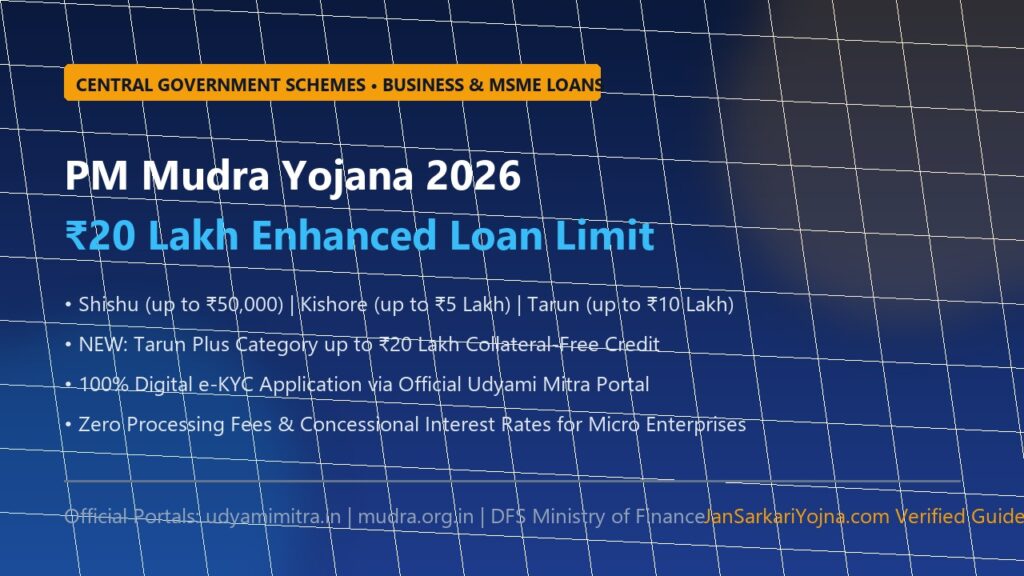
The Pradhan Mantri Mudra Yojana (PMMY), widely known as the PM Mudra Yojana, serves as the cornerstone of India’s collateral-free credit framework for micro and small enterprises. Launched by the Department of Financial Services (DFS), Ministry of Finance, the scheme empowers non-corporate, non-farm small and micro enterprises to secure institutional capital without offering physical collateral or third-party guarantees. Under recent Union Budget reforms, the government announced a historic enhancement of the maximum loan ceiling, introducing the Tarun Plus tier which extends credit limits up to ₹20 lakh for entrepreneurs with a proven repayment track record.
Micro-enterprises, small shopkeepers, artisans, service professionals, food processing units, and transport operators often encounter insurmountable barriers when seeking formal bank financing. Traditional commercial banking requires land deeds, hypothecation of assets, or extensive balance sheet histories that small entrepreneurs simply cannot furnish. The PM Mudra Yojana resolves this credit deficit by mobilizing public sector banks, private scheduled banks, regional rural banks (RRBs), small finance banks (SFBs), and non-banking financial companies (NBFCs) backed by the Credit Guarantee Fund for Micro Units (CGFMU). This comprehensive reference guide provides a definitive walkthrough of the revised four-tier loan hierarchy, interest structures, borrower eligibility parameters, documentation mandates, and the digital application procedure on the official udyamimitra.in portal.
Four Lending Categories Under PM Mudra Yojana 2026
To cater to businesses at varying developmental stages, the PM Mudra Yojana categorizes loan products into four distinct tiers based on the capital requirements of the borrower:
| Loan Category | Loan Amount Threshold | Target Enterprise Stage | Repayment Tenure |
|---|---|---|---|
| Shishu | Up to ₹50,000 | Startups, tiny ventures, roadside kiosks, and first-generation micro-entrepreneurs | Up to 5 years (60 months) |
| Kishore | Above ₹50,000 to ₹5,00,000 | Operational units purchasing inventory, machinery, or expanding business capacity | 3 to 5 years |
| Tarun | Above ₹5,00,000 to ₹10,00,000 | Established micro-enterprises acquiring commercial transport, industrial equipment, or facility upgrades | Up to 7 years |
| Tarun Plus (New) | Above ₹10,00,000 to ₹20,00,000 | Graduating entrepreneurs who successfully repaid prior Tarun loans and are scaling manufacturing or trade | Up to 7 years |
The introduction of the Tarun Plus category (₹10 lakh to ₹20 lakh) directly addresses the funding crunch encountered by flourishing micro-units that outgrew the ₹10 lakh ceiling but struggled to qualify for conventional corporate loan structures. Under the CGFMU framework managed by the National Credit Guarantee Trustee Company (NCGTC), the Central Government guarantees default risks up to 75% to 85% of outstanding portfolio exposure, incentivizing commercial lenders to disburse high-value capital without demanding mortgaged property.
Detailed Eligibility Criteria for PM Mudra Loan Applicants
The PM Mudra Yojana maintains broad and inclusive eligibility benchmarks to ensure widespread penetration across rural, semi-urban, and metropolitan trade hubs:
- Eligible Business Types: Any Indian citizen operating a proprietorship firm, partnership enterprise, small manufacturing workshop, retail shop, repair center, service agency, agricultural allied service (such as poultry, dairy, fisheries, or agro-processing), or transport enterprise.
- Applicant Age Requirements: Minimum entry age of 18 years at the time of application. While the standard upper age ceiling is 65 years, the repayment tenure must culminate prior to the applicant reaching maximum age thresholds set by participating banks.
- Credit Score and History: Borrowers must not be classified as willful defaulters or have past unresolved Non-Performing Asset (NPA) accounts with any commercial bank, cooperative lender, or financial institution. A healthy CIBIL or credit bureau score (650 and above) expedites rapid loan sanction.
- Special Prerequisite for Tarun Plus: To unlock the ₹10 lakh to ₹20 lakh window, the applicant enterprise must have previously availed and fully or satisfactorily serviced a Tarun-tier loan without default.
- Excluded Activities: Direct primary agricultural farming (crop cultivation, paddy farming, land purchase) is excluded from PMMY, as agricultural credit is separately covered under specialized crop loan facilities and the Kisan Credit Card (KCC) framework.
Permissible Activities and Eligible Business Sectors
Loans extended under PM Mudra Yojana must be dedicated exclusively to income-generating commercial activities. Typical sanctioned activities include:
- Commercial Transport Vehicles: Purchase of auto-rickshaws, small commercial transport trucks, e-rickshaws, passenger taxis, tractors, and agricultural product transport trolleys.
- Service Sector Enterprises: Hair salons, tailoring boutiques, dry-cleaning units, photocopying and digital service kiosks, dental clinics, fitness centers, and repair workshops.
- Food and Beverage Products: Papad making, pickle processing units, bakery establishments, cold storage facilities, confectionery production, catering services, and small restaurant franchises.
- Textile and Handloom Crafts: Powerloom operations, embroidery units, apparel designing, zari work, cotton ginning, and garment manufacturing workshops.
- Retail Traders and Shopkeepers: Kirana stores, medical pharmacies, stationery shops, hardware outlets, electrical appliance dealerships, and electronic repair hubs.
Financial Terms: Interest Rates, Collateral, and Processing Fees
The financial architecture of the PM Mudra Yojana delivers distinct advantages over informal money-lenders and non-institutional credit sources:
| Parameter | Official Regulatory Provision |
|---|---|
| Collateral Security | Strictly Nil: Reserve Bank of India (RBI) mandates zero collateral or third-party guarantee for all loans up to ₹10 lakh and approved Tarun Plus brackets under CGFMU coverage. |
| Interest Rate Range | Floating rates tied to External Benchmark Lending Rate (EBLR) or Marginal Cost of Funds Based Lending Rate (MCLR), typically ranging from 8.50% to 12.50% per annum depending on lender classification. |
| Processing Charges | Zero processing fees for Shishu category (up to ₹50,000). For Kishore, Tarun, and Tarun Plus, banks may levy nominal processing charges capped at 0.50% of the loan amount plus applicable GST. |
| Margin Money Contribution | Shishu: Nil (100% project financing). Kishore & Tarun: Typically 10% to 15% borrower margin money contribution. Tarun Plus: 15% to 20% promoter contribution. |
| Working Capital Facility | Provided through the Mudra Card, a RuPay-enabled debit card linked to an overdraft cash credit account, permitting seamless point-of-sale withdrawals and interest calculation strictly on utilized amounts. |
Comprehensive Documentation Checklist
To eliminate processing bottlenecks, loan applicants must assemble verified documentation prior to submitting physical files or initiating online digital login:
- Identity Verification: Aadhaar Card, PAN Card, Voter ID, Passport, or Valid Driving License.
- Residential Proof: Recent electricity utility bill, registered lease agreement, property tax receipt, or bank passbook displaying residential coordinates.
- Business Establishment Proof: Udyam Registration Certificate (MSME registration), GST Registration Certificate, Shop and Establishment Act license, or trade license issued by municipal authorities.
- Financial Documentation (Kishore, Tarun, Tarun Plus): Past 12 months audited bank account statements, projected balance sheet for 1 to 2 years, Income Tax Returns (ITR) for the preceding two assessment years (mandatory for loans exceeding ₹5 lakh), and estimated quotation bills for machinery or capital equipment to be purchased.
- Asset-Liability Statement: Self-attested declaration of current personal and business assets, liabilities, and ongoing credit obligations.
- Passport Photographs: Two recent passport-size color photographs of all proprietors, partners, or corporate directors.
Step-by-Step Online Application Process on Udyami Mitra Portal
The Central Government facilitates unified online submission across all participating national banks through the official Small Industries Development Bank of India (SIDBI) digital portal. Follow these exact sequential steps to submit your digital loan dossier:
Step 1: Access the Official Digital Lending Portal
Navigate to the government digital platform at https://udyamimitra.in or the central scheme informational portal at https://mudra.org.in and https://financialservices.gov.in. On the homepage, select the option labeled Apply for Mudra Loan to enter the unified credit application system.
Step 2: User Registration and OTP Authentication
Create an applicant profile by entering your full legal name, active mobile number, and verified email address. Complete the two-factor authentication by submitting the One-Time Password (OTP) received on your registered mobile handset.
Step 3: Enterprise Profile and Category Selection
Log in using your validated credentials and select the appropriate funding category: Shishu (up to ₹50,000), Kishore (₹50,000 to ₹5 lakh), Tarun (₹5 lakh to ₹10 lakh), or Tarun Plus (₹10 lakh to ₹20 lakh). Enter your 12-digit Udyam Registration Number to allow automated digital verification of business classification.
Step 4: Financial Dossier and Quotation Upload
Complete the electronic application form by supplying business projections, turnover details, and capital expenditure needs. Upload high-resolution scanned copies of your PAN card, Aadhaar e-KYC consent, bank statements, and supplier equipment invoices in PDF format.
Step 5: Preferred Lender Selection and Electronic Submission
The portal enables applicants to choose up to three preferred lending institutions (e.g., State Bank of India, Punjab National Bank, Bank of Baroda, or local regional rural banks) operating within their commercial district. Review the comprehensive declaration and submit your application to receive a unique digital Application Reference Number (ARN) for tracking loan appraisal status.
Mudra Card: Digital Working Capital Mechanism
Upon loan sanction, a significant portion of working capital credit is issued in the form of the innovative Mudra Card. Operating on the domestic RuPay payment rails, the Mudra Card functions as a digital credit line linked to the borrower’s Cash Credit (CC) account. Key features include:
- Anytime Liquidity: Entrepreneurs can withdraw funds from automated teller machines (ATMs) across India or swipe the card at merchant POS terminals to purchase inventory and raw materials directly.
- Interest Optimization: Interest is calculated strictly on the daily outstanding debit balance rather than the total sanctioned limit, saving substantial finance costs compared to conventional term disbursements.
- Flexible Prepayment: Borrowers can deposit daily surplus cash back into the linked account at any time, lowering their balance and immediately decreasing interest liabilities.
Synergy with National Livelihood and Enterprise Ecosystems
The PM Mudra Yojana serves as a vital bridge within India’s broader social welfare and self-reliance framework. Artisans, traditional craftspeople, and trade professionals who complete certified skill training under the PM Vishwakarma Yojana can leverage their enterprise credentials to access Kishore and Tarun credit lines for scaling mechanical workshops. Similarly, women entrepreneurs organized under Self-Help Groups (SHGs) through the Lakhpati Didi Yojana utilize Mudra micro-loans to establish micro-manufacturing clusters and food packaging businesses.
For youth seeking corporate internships and practical industry exposure before launching their own commercial enterprises, the PM Internship Scheme provides valuable on-the-job managerial skills and monthly allowances. Unorganized micro-business workers should also secure social security protections via e-Shram Card Registration, while ensuring family elders are insulated from unexpected medical expenses through the universal Ayushman Bharat 70 Plus Senior Citizen Card healthcare cover.
Frequently Asked Questions (FAQ)
Is collateral security or property mortgage mandatory for PM Mudra Yojana loans?
No. Under the direct guidelines issued by the Reserve Bank of India and the Department of Financial Services, lenders are strictly prohibited from demanding any physical collateral, mortgage of real estate, or third-party guarantee for loans sanctioned under PM Mudra Yojana across Shishu, Kishore, Tarun, and Tarun Plus categories.
Can I apply for a PM Mudra loan to purchase personal consumer goods or a private car?
No. PM Mudra Yojana loans are strictly earmarked for commercial business activities, enterprise setup, machinery procurement, inventory purchase, or commercial vehicle acquisition (taxis, delivery vans, three-wheelers) that directly generate employment and revenue.
What is the maximum loan limit under the newly expanded Tarun Plus category?
Under the revised guidelines, the maximum credit ceiling under the Tarun Plus category is ₹20 lakh. This enhanced bracket is reserved specifically for entrepreneurs who previously availed and fully or satisfactorily repaid credit under the standard Tarun tier (up to ₹10 lakh).
How can an applicant track their Mudra loan application status online?
Applicants who submitted their loan file through the official digital portal can track real-time appraisal updates by logging into https://udyamimitra.in using their registered mobile number and Application Reference Number (ARN).
Are private limited companies eligible for PM Mudra Yojana?
No. Corporate entities, public limited companies, and large industrial corporations are not eligible. The scheme is exclusively crafted for non-corporate small business segments (NCSBs), including individual proprietorships, partnership firms, small limited liability partnerships, and micro-enterprises.
Disclaimer: JanSarkariYojna.com is an independent public-information platform. We are not affiliated with any government ministry or agency. Verify all scheme guidelines on the respective official government portal (.gov.in / .nic.in).