


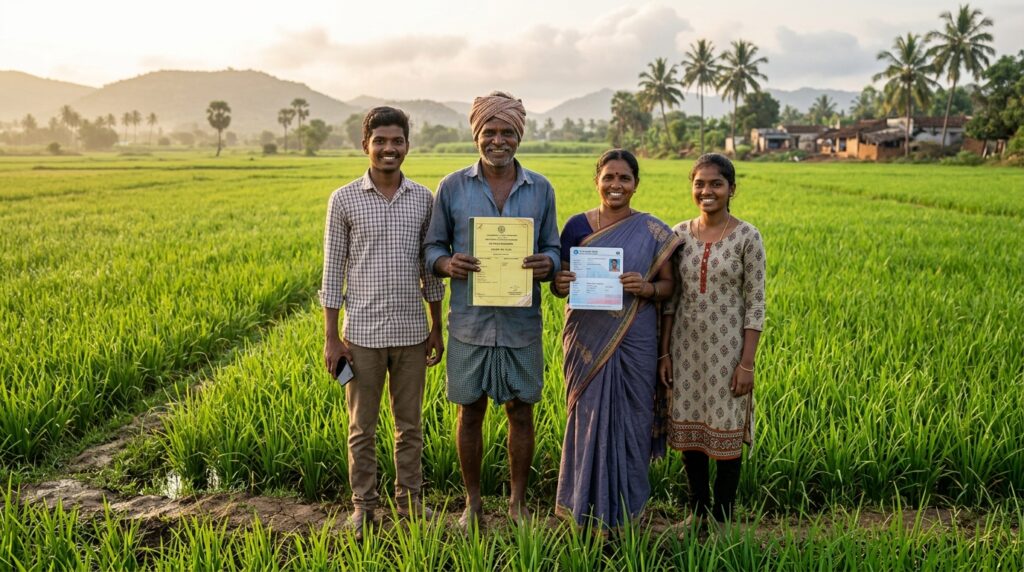
Introduction to Thalliki Vandanam Scheme
Sustained educational participation and the eradication of child labor depend heavily on empowering mothers to meet their children’s schooling expenses. The Thalliki Vandanam Scheme, implemented by the Department of School Education in Andhra Pradesh, is a landmark direct financial support initiative that transfers ₹15,000 per academic year directly into the bank accounts of mothers who send their children to school from Class 1 to Class 12.
Table of Contents
The program aims to eliminate school dropouts caused by financial distress, improve student attendance, and promote female literacy. By incentivizing parents to enroll children in formal schooling institutions, Andhra Pradesh has recorded substantial improvements in Gross Enrollment Ratios across primary and secondary educational stages.
Core Features & Program Summary
| Feature | Operational Parameter |
|---|---|
| Scheme Name | Thalliki Vandanam (formerly Amma Vodi framework) |
| Department | Department of School Education, Andhra Pradesh |
| Annual Financial Benefit | ₹15,000 directly deposited to the mother’s bank account |
| Educational Scope | Class 1 to Class 12 (including Intermediate colleges) |
| Eligible Institutions | Government, aided, and recognized private schools and junior colleges |
| Mandatory Condition | Minimum 75% student classroom attendance |
| Official Portal | cse.ap.gov.in / jaganannaammavodi.ap.gov.in |
Financial Benefit Breakdown & School Amenities Fund
Under the scheme guidelines, the total financial entitlement is ₹15,000 per academic year per eligible family. Of this total allocation:
- ₹14,000 Net DBT Credit: Transferred straight into the mother’s verified, Aadhaar-enabled bank account for meeting textbooks, uniforms, transport, and nutrition requirements.
- ₹1,000 School Maintenance Fund (TMF): Allocated toward the School Sanitation and Toilet Maintenance Fund (TMF) to ensure clean toilets, drinking water facilities, and hygienic infrastructure across public educational institutions.
Eligibility Criteria for Mothers and Guardians
To qualify for the annual Thalliki Vandanam grant, applicant families must satisfy the following statutory conditions:
- The mother (or legal guardian in the absence of the mother) and child must be permanent residents of Andhra Pradesh.
- The student must be enrolled in Class 1 through Class 12 in a recognized government, municipal, tribal welfare, aided, or private educational institution.
- The student must maintain a verified minimum classroom attendance of 75% across the academic academic year.
- The family must possess an active Rice Card or have a verified household annual income under ₹1.2 Lakh in rural areas (or ₹1.44 Lakh in urban areas).
- The mother must hold an operational bank account seeded with Aadhaar and mapped with the National Payments Corporation of India (NPCI).
Ineligibility Criteria
Financial support under Thalliki Vandanam is not available to households meeting any of the following exclusion clauses:
- Families of regular government employees, officers, or retired pensioners (excluding sanitary workers and daily-wage municipal workers).
- Families with members paying commercial Income Tax.
- Households owning a four-wheeler vehicle for private use (excluding tractors, auto-rickshaws, and commercial cabs operated for livelihood).
- Households consuming more than 300 units of domestic electricity per month on average.
Verification and Application Flow
The application and data synchronization process operates seamlessly through educational and revenue registries:
- Child Info Portal Registration: School principals and headmasters record the student’s admission, Aadhaar details, and parent information on the Child Info / U-DISE state portal.
- Attendance Synchronization: Biometric and facial recognition attendance data logged by schools are synced periodically with the Department of School Education database.
- Grama / Ward Sachivalayam Social Audit: Preliminary verification lists are displayed at local Village and Ward Secretariats for public verification. Welfare and Education Assistants assist parents in resolving data discrepancies.
- Final Approval and DBT Release: The District Educational Officer (DEO) approves the authenticated master roster, followed by electronic fund transfer via Aadhaar Payment Bridge.
Frequently Asked Questions (FAQs)
1. Does the scheme apply if my child studies in a private school?
Yes. The scheme covers students enrolled in recognized private schools as long as the family meets the economic eligibility criteria and the child maintains 75% attendance.
2. Can a legal guardian receive the benefit if the mother is deceased?
Yes. In cases where the mother has passed away, the registered legal guardian or grandmother can be nominated as the recipient upon verification by the local revenue officer.
3. What if a mother has more than one child studying in school?
Under updated state governance rules, the welfare assistance aims to support universal education per mother, with extended provisions for families supporting multiple students according to cabinet guidelines.
Disclaimer: JanSarkariYojna.com is an independent educational and public information portal. We are not affiliated with the Government of Andhra Pradesh. Beneficiaries must verify all official notices and administrative criteria on the official state portal at cse.ap.gov.in.
Thalliki Vandanam Scheme 2026 School Assistance Standards
The School Education Department of Andhra Pradesh enforces inclusive educational empowerment under Thalliki Vandanam Scheme 2026:
| Beneficiary Criteria | Statutory Rule | Financial Allocation |
|---|---|---|
| Target Recipient | Biological mother / recognized legal guardian | ₹15,000 annually per eligible school student |
| Class Range Covered | Class 1 through Class 12 (Junior Intermediate) | Govt, aided, and recognized private schools |
| Mandatory Attendance | Minimum 75% student attendance record | Cross-verified via Child Info database |
| Multiple Children Rule | Extended to every schooling child in the family | Full benefit granted for all enrolled children |
Step-by-Step Online & Offline Application Protocol
To enroll smoothly under Thalliki Vandanam Scheme 2026 and ensure immediate biometric verification and sanctioning, citizens should adhere to the following certified procedure:
- Access the Official Portal: Visit the official government portal (School Education Department AP) to review designated scheme guidelines.
- Aadhaar Demographic Seeding: Confirm that your identity, age, and family relationships in your Aadhaar card match your registered state revenue records.
- Bank APBS Verification: Ensure your savings bank account is enabled for Direct Benefit Transfer (DBT) and mapped to the NPCI Aadhaar Payment Bridge.
- Document Upload: Scan and attach original supporting certificates (residence proof, caste certificate, land records or income proof) before submitting.
- Track Sanction Order: Use your registration acknowledgement ID to monitor application verification milestones through your local district portal.
Related Government Welfare Programs & Links
Explore other beneficial welfare initiatives and credit subsidies:
- Read our comprehensive guide on the Vidyakiranam Scheme Kerala for financial grants.
- Check out the latest details regarding the Pragyan Bharati Scheme Assam for subsidy updates.
Frequently Asked Questions (FAQs) – Thalliki Vandanam Scheme 2026
What is the annual financial grant under Thalliki Vandanam Scheme 2026?
The Government of Andhra Pradesh grants ₹15,000 per annum per school-going child, directly credited into the biological mother’s bank account.
Is the benefit limited to only one child per mother?
Under revised scheme guidelines, financial assistance is extended to every schooling child in the household from Class 1 to Class 12.
What is the minimum mandatory school attendance requirement?
Students must maintain at least 75% attendance in the academic year to qualify for the annual cash incentive.
Are children enrolled in private un-aided schools eligible?
Yes. Students studying in government schools, aided schools, and recognized private schools are all eligible.
What documents are needed to verify the mother’s account?
Mother and child’s Aadhaar cards, school admission student ID (Child Info Code), white ration card, and active bank passbook seeded with NPCI.