
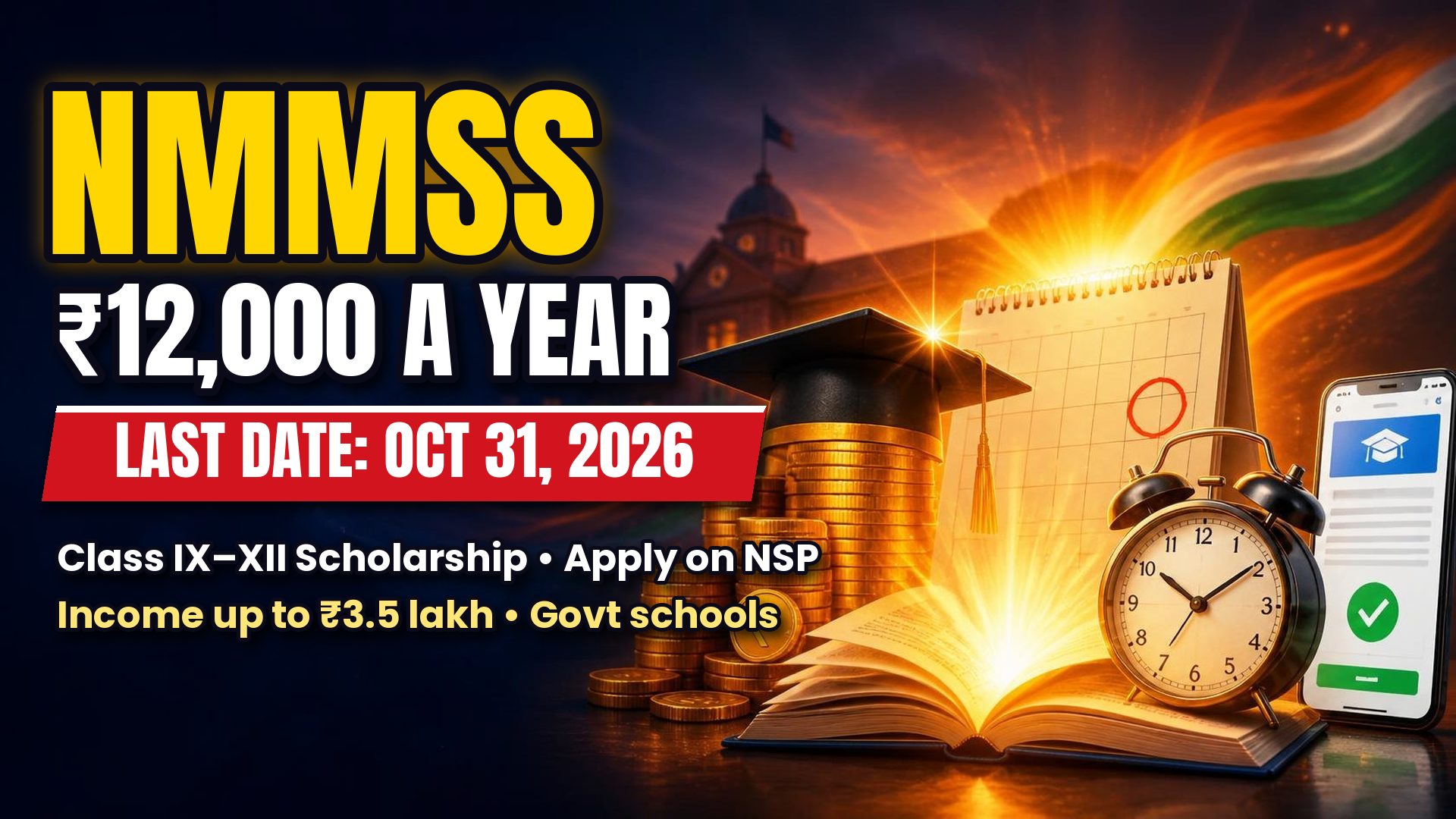
India sets aside one lakh fresh National Means-cum-Merit scholarships every year — and by September 30, 2026, only 88,522 fresh applications had reached the National Scholarship Portal. In other words, the number of new applications was still below the number of new scholarships on offer, with the original August 31 deadline and a first extension to September 30 both gone. On October 1, the Ministry of Education extended the last date again, to October 31, 2026. So the real question for a Class IX student in a government school is simple: if you cleared your state’s NMMSS exam, why haven’t you applied yet — and what could still go wrong?
This guide to the NMMSS scholarship 2026-27 walks through what changed, who qualifies, how the money flows, and the small mistakes that quietly cancel a ₹12,000-a-year scholarship. Rules can be revised, so always check the official portal for the latest before you act.
What Changed on October 1, 2026
According to the Press Information Bureau release of October 1, 2026, the Union Ministry of Education extended the NMMSS application window for academic year 2026-27. The portal has been open since June 1, 2026. The revised schedule is:
| Step | Last date |
|---|---|
| Student submits application on NSP | October 31, 2026 |
| Institute Nodal Officer (L1) verification | November 15, 2026 |
| District Nodal Officer (L2) verification | November 30, 2026 |
PIB also reported that, as of September 30, 2026, 88,522 fresh and 1,97,133 renewal applications had been submitted. The renewal figure is larger because students already in Classes X, XI and XII must re-apply every year to keep the scholarship running.
The extension matters for one more reason: it is not only the student’s deadline. Your school and your district both have their own verification deadlines after you. An application that is submitted on October 31 but never verified by the school is, for practical purposes, an application that does not exist.
What NMMSS Actually Pays
The National Means-cum-Merit Scholarship Scheme was launched in 2008 to stop meritorious children from economically weaker families dropping out after Class VIII. Under the revised NMMSS guidelines issued by the Department of School Education & Literacy in March 2022:
- The scholarship is ₹12,000 per year, calculated at ₹1,000 per month.
- It starts in Class IX and can continue to Class XII — a maximum of four years.
- Over four years, that adds up to ₹48,000 for a student who keeps meeting the renewal conditions.
- Money is transferred directly to the student’s bank account through Direct Benefit Transfer (DBT) via the Public Financial Management System (PFMS), as the Ministry reiterated in its September 1, 2026 PIB release.
One caution: older web pages, coaching notes and forwarded messages sometimes still quote an income limit of ₹1.5 lakh. That is the pre-2022 figure. The March 2022 revised guidelines record that the parental income ceiling was raised from ₹1.50 lakh to ₹3.50 lakh a year, and the October 2026 PIB release repeats ₹3.5 lakh and ₹12,000 a year. When two sources disagree, the newer official notification is the one that applies — which is exactly why you should read the current guideline PDF instead of a forwarded message.
Who Is Eligible — and Who Is Quietly Excluded
NMMSS is a “means plus merit” scheme. You have to pass both tests.
The means test. Parental income from all sources must not exceed ₹3.50 lakh per year, as confirmed by the PIB release and the official NMMSS FAQ on the National Scholarship Portal.
The merit test. The guidelines set a ladder of marks:
- At least 55% in Class VII (or equivalent grade) to sit the selection test, with a 5-percentage-point relaxation for SC/ST students.
- The state-level selection exam in Class VIII has two papers — a Mental Ability Test (MAT) and a Scholastic Aptitude Test (SAT) — each with 90 multiple-choice questions over 90 minutes.
- To qualify, a student needs 40% aggregate across both papers (32% for SC/ST).
- At the time of selection, the student must also have 55% in Class VIII (5% relaxation for SC/ST).
The school test. This is where many families get caught. The scholarship is only for regular students in government, government-aided and local body schools. The guidelines specifically exclude:
- Students of Kendriya Vidyalayas and Jawahar Navodaya Vidyalayas
- Students in residential schools run by the Centre or State that provide boarding, lodging and education
- Students in private schools
So a child who clears the NMMSS exam and then moves to a Navodaya or a private school in Class IX loses eligibility. That is worth knowing before a family takes an admission decision.
Finally, note a change for 2026-27. The 2022 guidelines allowed only one Central Government scholarship per student, but PIB said on August 6, 2026 that from the 2026-27 academic year students may apply for one merit-based scholarship scheme and one or more welfare-based scholarship schemes at the same time, subject to each scheme’s eligibility rules. Check the current rules on NSP before applying for more than one.
How Many Seats Your State Has
Scholarships are not one national merit list. Each State and UT has a fixed quota, worked out by the Ministry using enrolment in Classes VII–VIII and child population. Annexure-I of the 2022 guidelines lists, for example (selected states, not a ranking):
| State | NMMSS quota (2022 guidelines) |
|---|---|
| Uttar Pradesh | 15,143 |
| Maharashtra | 11,682 |
| West Bengal | 7,250 |
| Tamil Nadu | 6,695 |
| Madhya Pradesh | 6,446 |
| Bihar | 5,433 |
The total across all States and UTs is 1,00,000. The guidelines note that state quotas may be revised, so treat these as the latest published figures rather than a promise. State reservation norms also apply within each quota.
How to Apply on the National Scholarship Portal
All applications — fresh and renewal — go through the National Scholarship Portal (NSP). Based on the PIB release and the NSP FAQ, the process is:
- Complete One-Time Registration (OTR) on NSP. PIB states that OTR is mandatory before applying.
- Log in and choose NMMSS (fresh if you were selected in the Class VIII exam; renewal if you are already a scholar).
- Fill the form carefully. Fields marked with a red asterisk are mandatory. You can save a draft and return later, but once you click final submit, the form moves to the next level and you cannot edit it.
- Note your Application ID. The FAQ says you will need it for renewal in later years.
- Hand over documents to your school for verification. The NSP FAQ says no documents need to be uploaded online, but the school will ask for the income certificate of the parent or guardian issued by the competent authority and, where relevant, the caste certificate. If your state issues these digitally, keeping copies in DigiLocker can make the paperwork easier.
- Follow up with your school before November 15 and confirm the district verification before November 30.
If the school marks your form as “defected”, it comes back to you for correction within the portal timeline. If it is marked “rejected”, the FAQ is blunt: it will not be considered for the scholarship.
The Bank-Account Trap That Blocks Payments
A surprising number of NMMSS problems are not about eligibility at all — they are about the bank account. The NSP FAQ lists clear instructions:
- Enter the IFSC code and full account number carefully, and get the number verified at the branch.
- Make sure the account’s KYC is complete and the account is active, not dormant, until the money arrives.
- Seed Aadhaar with the account. Under Aadhaar-based payment, if the student’s Aadhaar is linked to a bank account, the scholarship is credited to that Aadhaar-linked account — even if a different account was typed into the form.
That last rule surprises many families. If an old account is Aadhaar-seeded and you entered a new one, the money may still go to the old account. Check with your bank which account is currently mapped to the Aadhaar number.
To check whether money has been credited, the FAQ points to the “Know Your Payment” option on the Public Financial Management System (PFMS). For payment queries, NSP lists the PFMS toll-free helpline 1800 118 111.
Renewal Rules: How Students Lose the Scholarship
Getting selected is only step one. The guidelines set strict conditions for continuation:
- Clear promotion in the first attempt from Class IX to X, and from Class XI to XII.
- At least 60% in Class X to continue into Classes XI and XII (55% for SC/ST).
- Re-apply on NSP every year within the deadline — the guidelines say the scholarship is discontinued if the renewal is not done on time.
- No gap year. A gap of one academic session ends the scholarship.
- Once discontinued, it cannot be revived under any circumstances.
- The student must continue as a regular, full-time student with good conduct certified by the head of the institution.
This is why the 1,97,133 renewal applications in the PIB data matter. Each of those students has to clear the same portal and verification steps every year. Missing one renewal window can wipe out the remaining instalments of a four-year award.
Five Insights for Families and Schools
- The deadline is a chain, not a date. October 31 is the student’s date; November 15 and November 30 are the school’s and district’s. Submitting on the last day leaves no margin for a “defected” correction.
- Applications trail the quota. PIB’s own numbers show fresh applications below the one-lakh fresh scholarships available as of September 30. If you were selected in your state’s exam and have not applied, the extension is your window — do not assume someone else will apply for you.
- School type decides everything. Clearing the exam does not help if the student is in a KV, JNV, government residential school or private school in Class IX.
- The Aadhaar-seeded account wins. Know which bank account is linked to the student’s Aadhaar before you submit.
- Renewal is where the money is lost. Over four years the award can total ₹48,000, but a missed renewal or a Class X result below 60% (55% for SC/ST students) can end it.
Where to Get Help
The NSP FAQ lists a complaint page on the portal, a helpline at 0120-6619540 (8 AM–8 PM on all days except government holidays, per NSP), and the email helpdesk@nsp.gov.in for technical issues. State nodal officer contacts are also published on NSP. For background on how the Centre runs school-level programmes, you can also read our guide to the PM SHRI School scheme and the Bharatiya Bhasha Pustak Scheme, or browse all our Central Government Schemes.
What Happens Next
Here is the watch-list for the next eight weeks:
- By October 31, 2026: fresh and renewal applications must be submitted on NSP.
- By November 15, 2026: school-level (L1) verification closes.
- By November 30, 2026: district-level (L2) verification closes.
- Updated application counts: watch for whether fresh applications catch up with the one-lakh quota after the extension.
- Next selection exam: the guidelines say states hold the NMMSS selection test for Class VIII students around November each year. Students now in Class VIII should check their state education department’s notice.
If you are eligible, do not wait for the last week. Submit early, keep your Application ID, carry your income certificate to school, and confirm your Aadhaar-linked bank account. Dates and rules can change, so check the official portal for the latest — scholarships.gov.in and the Ministry of Education NMMSS page — before you submit.
Disclaimer: jansarkariyojna.com is an independent information website and is not affiliated with the Ministry of Education or the National Scholarship Portal. The official notices on scholarships.gov.in and the Ministry of Education are the final authority. Submitting an application or receiving an Application ID does not guarantee a scholarship — the award depends on selection in your State/UT exam and on verification by your school, district and the Ministry. Apply only on the official NSP yourself, through your school, or at a Common Service Centre (NSP lists a fixed CSC charge of ₹30 for OTR and the full application); do not pay any agent or website that promises to get you selected.