
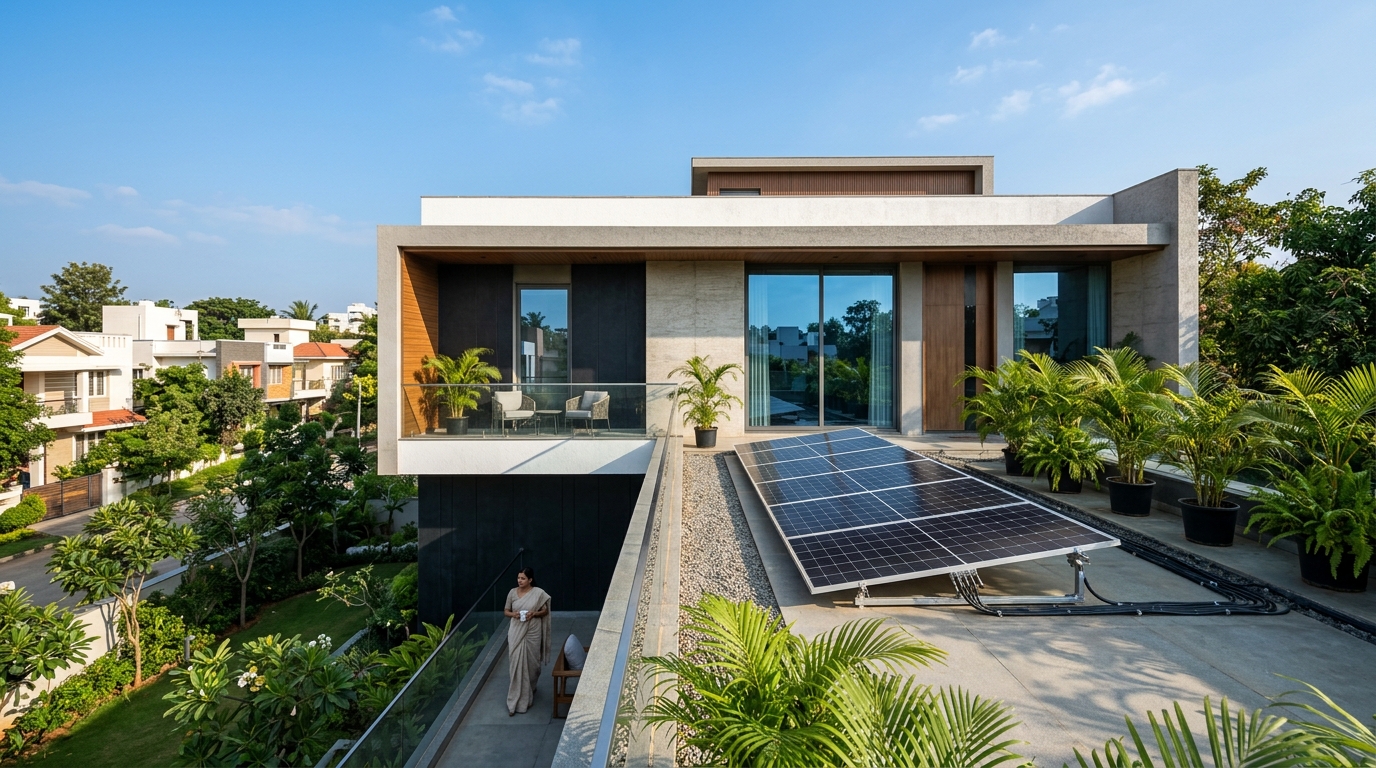
Household power bills across India have climbed steadily over recent years, driven by seasonal peak consumption, tariff revisions by state distribution companies (DISCOMs), and increasing reliance on air conditioning and electrical appliances. In response, the Central Government rolled out one of its most ambitious decentralized energy initiatives: the PM Surya Ghar: Muft Bijli Yojana. With an approved budgetary outlay of ₹75,021 crore, the scheme aims to install rooftop solar photovoltaic systems on one crore residential homes across the country, providing up to 300 units of free electricity every month and creating long-term monthly savings for middle-class and rural families.
While the promise of near-zero electricity bills is attractive, the actual journey from online registration to money reaching your bank account involves multiple administrative checkpoints. Consumers often get caught up in confusion over subsidy calculations, technical feasibility approvals from state DISCOMs, net metering protocols, and vendor contracts. This comprehensive guide breaks down the scheme’s verified financial assistance slabs, step-by-step digital application process, vendor selection criteria, and recent procedural safeguards introduced on the National Portal.
What is PM Surya Ghar: Muft Bijli Yojana?
Formally notified by the Ministry of New and Renewable Energy (MNRE), PM Surya Ghar replaces the earlier grid-connected rooftop solar phase. Rather than channeling subsidies through complicated bureaucratic layers or state intermediaries, the current framework operates on an end-to-end digital architecture anchored by the National Portal at pmsuryaghar.gov.in. Under this scheme, financial assistance (Central Financial Assistance or CFA) is credited directly into the consumer’s bank account via Direct Benefit Transfer (DBT) within approximately thirty days following installation and DISCOM inspection.
The program is targeted strictly at residential consumers. Commercial buildings, industrial units, and non-residential complexes are ineligible for the central residential subsidy, although specialized provisions exist for common lighting and electric vehicle charging in registered housing societies.
Verified Central Subsidy Structure (CFA Slabs for 2026)
The financial incentive provided under PM Surya Ghar is pegged to the rated kilowatt (kW) capacity of your rooftop solar plant. The subsidy does not increase indefinitely with plant size; it is carefully tiered to favor standard domestic residential loads.
| Rooftop Solar Plant Capacity | Central Financial Assistance (Subsidy) | Estimated Daily Generation | Ideal Monthly Electricity Consumption |
|---|---|---|---|
| 1 kW System | ₹30,000 | 4 to 4.5 Units | Up to 150 Units / Month |
| 2 kW System | ₹60,000 (₹30,000 per kW) | 8 to 9 Units | 150 to 300 Units / Month |
| 3 kW System | ₹78,000 (₹60,000 + ₹18,000 for 3rd kW) | 12 to 14 Units | 300 to 450 Units / Month |
| Above 3 kW (Up to 10 kW) | Capped at ₹78,000 maximum | 16+ Units | Heavy domestic loads (Multiple ACs) |
| Group Housing Societies / RWAs | ₹18,000 per kW (up to 500 kW capacity) | Shared common services | Common lighting, lifts, water pumps, EV charging |
Crucial Math Note: For residential homes, the subsidy maxes out at ₹78,000. If your home requires a 5 kW or 7 kW setup due to multiple air conditioners and heavy appliances, you are fully permitted to install that higher capacity, but the central subsidy will remain capped at ₹78,000. Any balance expenditure must be borne by the homeowner or financed through bank credit.
In addition to central subsidies, certain states offer complementary top-up assistance. If you are comparing central incentives with localized mountain or regional programs, reviewing state-specific frameworks such as the Uttarakhand Mukhyamantri Saur Swarojgar Yojana provides valuable context on how state and central renewable initiatives interact.
Eligibility Criteria for Residential Applicants
To qualify for the rooftop solar subsidy, applicants must satisfy the following fundamental parameters:
- Citizenship & Residency: The applicant must be a resident citizen of India.
- Premises Ownership: The applicant must own the residential property where the rooftop plant will be erected. Tenants cannot apply on behalf of a rented property unless the registered owner submits the application.
- Valid Grid Connection: The residence must have an active domestic electricity connection registered in the name of the applicant or a direct family member. Agricultural and commercial power connections are excluded.
- Adequate Shadow-Free Roof Space: A typical residential solar installation requires roughly 100 square feet of clean, unshaded rooftop space per kilowatt of installed capacity. A 3 kW setup requires approximately 300 square feet of unobstructed terrace or pitched roof.
- Aadhaar-Seeded Bank Account: Because the subsidy is disbursed through DBT, the applicant’s bank account must be operational and linked with their Aadhaar number to prevent electronic transfer failures.
Collateral-Free Low-Interest Bank Loans (JanSamarth Portal)
Recognizing that an initial investment of ₹1.5 lakh to ₹2 lakh for a 3 kW system can pose liquidity constraints for middle-income households, the government coordinated with leading public sector and private banks (including SBI, Punjab National Bank, Canara Bank, and Bank of Baroda) to offer collateral-free rooftop solar loans.
Key features of the concessional financing package include:
- Concessional Interest Rates: Loans up to 3 kW are offered at special repo-linked rates, typically around 7% per annum (significantly lower than standard personal loans).
- Minimal Down Payment: Homeowners generally need to invest only 10% to 15% of the total project cost out of pocket.
- Repayment Tenure: Flexible repayment horizons ranging up to 10 years, structured so that monthly electricity bill savings largely offset the loan EMI.
- Digital Application: Financing can be initiated directly through the JanSamarth digital portal (
jansamarth.in), which integrates with the national solar portal.
Step-by-Step Registration Process on pmsuryaghar.gov.in
The application workflow follows a mandatory, sequence-driven pathway to ensure safety, grid stability, and proper net meter synchronization.
Step 1: Consumer Registration on the National Portal
Visit the official portal at pmsuryaghar.gov.in and select the option to register. You will need to select your State, select your local Electricity Distribution Company (DISCOM), and enter your exact Consumer Account Number as printed on your latest electricity bill. Verify your mobile number via OTP to create your consumer dashboard.
Step 2: Technical Feasibility Approval (TFA)
Once logged into your dashboard, submit a formal application for rooftop solar capacity. Your state DISCOM will review your transformer capacity and sanction the Technical Feasibility Approval (TFA). This step confirms whether the local power grid can absorb your rooftop generation. Do not purchase solar hardware before receiving official TFA clearance.
Step 3: Selecting an Empaneled Solar Vendor
After TFA approval, you must select an installer from the list of registered, empaneled vendors visible in your portal dashboard. Critical warning: Installing through an unverified, non-empaneled local contractor will permanently disqualify your installation from receiving the central subsidy.
Sign an agreement with the vendor covering hardware specifications, safety warranties, and five years of mandatory comprehensive maintenance.
Step 4: Installation and DCR Module Compliance
The vendor erects the mounting structures, mounts the solar panels, installs a grid-tied inverter, and connects earthing pits and lightning arresters. Under MNRE guidelines, the solar photovoltaic modules must comply with Domestic Content Requirement (DCR)—meaning both the solar cells and modules must be manufactured domestically in India. The vendor must provide serial numbers and DCR certificates.
Step 5: DISCOM Net Metering and Commissioning Certificate
Once installation finishes, the vendor submits a work completion report on the portal. An authorized junior engineer from your state DISCOM visits your premises to conduct an on-site physical inspection. They inspect earthing, verify inverter synchronization, and replace your standard meter with a bidirectional Net Meter.
Following a successful inspection, the DISCOM issues an online Commissioning Certificate through the portal.
Step 6: Bank Details Submission and Direct Subsidy Disbursement
With the Commissioning Certificate generated, return to your dashboard on pmsuryaghar.gov.in. Upload a scanned copy of your cancelled bank cheque or the first page of your bank passbook showing your account number and IFSC code. Within 30 days of this submission, the central subsidy amount (up to ₹78,000) is credited directly to your bank account via PFMS/DBT.
Critical 2026 Procedural Update: The 70% Confidence Score Rule
To eliminate identity mismatches and fraudulent claims, the Ministry instituted an automated validation filter on the national portal. Applications whose automated data matching score (cross-referencing electricity connection records, Aadhaar details, and property data) registers below 70% are temporarily held.
If your application dashboard displays a low confidence score alert, you are required to download the prescribed digital undertaking form from the portal, sign it, and upload the signed document alongside valid government identity proof (Aadhaar or Voter ID). Resolving this documentation promptly prevents delays in technical feasibility approval and DBT subsidy sanction.
Common Reasons Applications Get Delayed or Rejected
Thousands of rooftop solar applicants experience avoidable delays. Understanding common stumbling blocks protects your timeline:
- Name Mismatch on Electricity Bill: If the electricity connection is registered under a deceased grandparent’s name while the application is filed by the grandson, the portal will reject the link. Update the name on your electricity meter with your DISCOM before applying.
- Non-DCR Solar Panels: Some disreputable contractors attempt to clear imported, non-DCR panels at discounted prices. Without official DCR certification, DISCOM will reject the commissioning report and zero subsidy will be released.
- Non-Seeded Bank Accounts: If your bank account is not mapped with the National Payments Corporation of India (NPCI) for Aadhaar DBT, the automated treasury transfer will bounce. Just as with welfare programs like the LPG Subsidy Aadhaar Biometric e-KYC, maintaining active biometric and banking synchronization is vital.
- Sanctioned Load Constraints: In many states, your approved solar capacity cannot exceed your sanctioned electricity meter load. If your home has a 2 kW sanctioned load and you request a 3 kW solar plant, you must apply to your DISCOM for a load enhancement first.
Frequently Asked Questions (FAQ)
Can tenants install rooftop solar under PM Surya Ghar?
No. The scheme requires structural roof rights and an electricity connection registered in the property owner’s name. Tenants cannot receive the subsidy directly unless the landlord applies and finances the installation.
How long does it take for the subsidy money to arrive after installation?
Once the DISCOM finishes net meter installation and issues the online Commissioning Certificate, and you submit your bank account details on the portal, the subsidy is typically disbursed via DBT within 30 days.
What happens to surplus electricity generated during sunny afternoons?
Surplus energy generated by your solar panels that is not immediately consumed in your home is fed into the state electricity grid through your bidirectional net meter. Your DISCOM credits these units against your nighttime or cloudy-day consumption on your monthly power bill.
Is maintenance covered under the installation contract?
Yes. Under the standardized MNRE guidelines, empaneled vendors are contractually bound to provide five years of comprehensive maintenance support, including inverter servicing and structural checks.
Disclaimer: JanSarkariYojna.com is an independent public-information platform. We are not affiliated with any government ministry or agency. Verify all scheme guidelines on the respective official government portal (.gov.in / .nic.in).
1 thought on “PM Surya Ghar Muft Bijli Yojana 2026: Complete Subsidy Slabs, Registration & DBT Rules”