
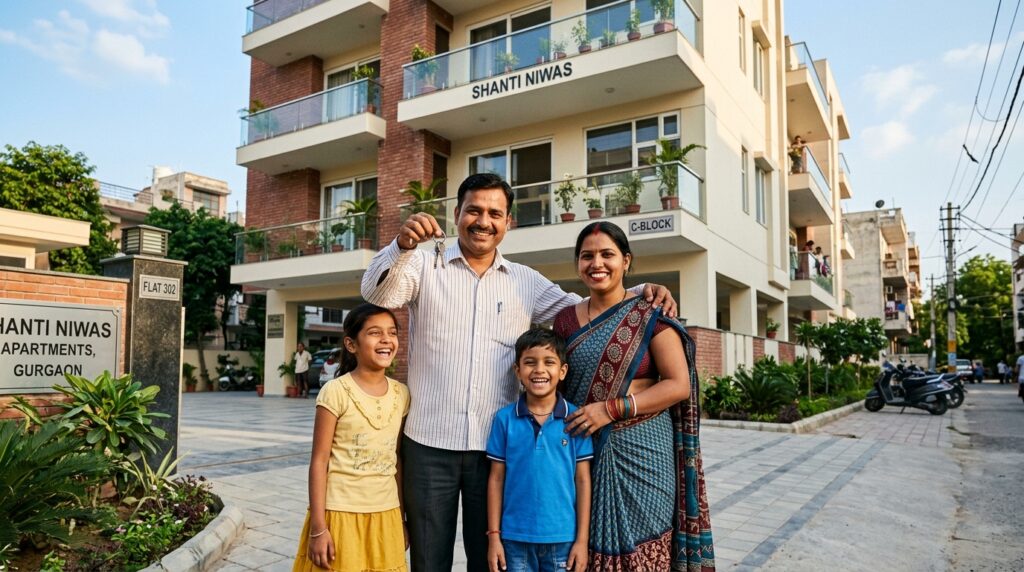
Securing permanent, dignified housing in India’s rapidly urbanizing landscape remains one of the primary financial aspirations of middle-class and economically weaker families. Following the monumental success of the initial urban housing mission, the Union Cabinet chaired by Prime Minister Narendra Modi officially sanctioned Pradhan Mantri Awas Yojana – Urban 2.0 (PMAY-U 2.0) under the Ministry of Housing and Urban Affairs (MoHUA). Backed by an unprecedented investment commitment of ₹10 lakh crore and central government assistance of ₹2.2 lakh crore over a five-year implementation window, the scheme is structured to address the housing requirements of one crore urban poor and middle-class households across India.
Unlike previous housing frameworks that focused primarily on slum redevelopment, PMAY-U 2.0 introduces powerful new pathways specifically designed for lower-middle and middle-income salaried workers who are burdened by surging urban property prices and commercial mortgage interest rates. This guide provides an in-depth breakdown of the four scheme verticals, revised income qualification slabs, the newly recalibrated 4% Interest Subsidy Scheme (ISS), mandatory woman ownership rules, and the step-by-step digital application protocol on the unified national housing portal.
The Four Implementation Verticals of PMAY-Urban 2.0
To cater to diverse housing requirements across metropolitan cities, tier-2 towns, and municipal census areas, PMAY-U 2.0 operates across four distinct programmatic verticals:
1. Beneficiary-Led Construction (BLC)
Individual families belonging to the Economically Weaker Section (EWS) who own a piece of land or an unplastered, dilapidated structure receive a flat financial assistance package of ₹2.50 lakh (combining central and state shares) to construct a permanent pucca house with a minimum carpet area of 30 square meters.
2. Affordable Housing in Partnership (AHP)
For urban families without independent land, public housing boards (such as DDA, MHADA, HUDA) and empaneled private developers construct planned apartment clusters. Eligible EWS beneficiaries receive direct subsidy allotments reducing the purchase price of the allotted flat.
3. Affordable Rental Housing (ARH)
Tailored specifically for migrant factory laborers, street vendors, students, and urban service workers, ARH creates temporary, affordable rental dormitory and apartment complexes near industrial corridors and economic clusters to prevent urban slum expansion.
4. Interest Subsidy Scheme (ISS) for Home Loans
The centerpiece of PMAY-U 2.0 for middle-income urbanites is the Interest Subsidy Scheme. Beneficiaries availing institutional home loans from commercial banks or housing finance companies for purchasing or constructing their first residential home receive an upfront 4% interest subvention on loan amounts up to ₹25 lakh (for property values up to ₹35 lakh). The subsidy amount—capped at up to ₹1.80 lakh—is credited in five equal annual tranches directly into the beneficiary’s loan account through Direct Benefit Transfer (DBT), effectively reducing the monthly EMI liability.
Income Categories and Qualification Slabs Under PMAY-U 2.0
Eligibility under PMAY-U 2.0 is categorized strictly by certified household income brackets:
| Income Category | Annual Household Income | Eligible Verticals | Maximum Carpet Area |
|---|---|---|---|
| Economically Weaker Section (EWS) | Up to ₹3,00,000 per annum | BLC, AHP, ARH, ISS | Up to 30 sq. meters |
| Low Income Group (LIG) | ₹3,00,001 to ₹6,00,000 per annum | AHP, ISS | Up to 60 sq. meters |
| Middle Income Group (MIG) | ₹6,00,001 to ₹9,00,000 per annum | ISS (Interest Subsidy) | Up to 90 sq. meters |
Mandatory Eligibility Criteria & Woman Ownership Rule
To ensure social equity and prevent speculative real estate hoarding, applicants must satisfy strict statutory conditions:
- Pucca House Prohibition: The beneficiary family (defined as husband, wife, and unmarried children) must not own a pucca house in their name anywhere in India.
- Female Ownership Mandate: In line with national gender-empowerment guidelines, the constructed or purchased property must be registered solely in the name of the female head of the family, or jointly with her spouse. Sole male ownership is only permitted in families with no surviving adult female member.
- Geographic Boundary: The property must fall within statutory urban agglomerations, municipal corporations, municipalities, or notified town planning areas as recognized in the latest Census.
- No Prior Housing Subsidies: Beneficiaries who have previously availed central assistance under PMAY-Gramin, PMAY-Urban 1.0, or other central housing programs are permanently barred.
Step-by-Step Online Application Process on pmay-urban.gov.in
Citizens can apply directly without hiring third-party middlemen or paying commission fees:
Step 1: Access the Unified PMAY-U 2.0 Portal
Navigate to the official portal at pmay-urban.gov.in. Select Citizen Assessment and choose the relevant scheme vertical (e.g., Interest Subsidy Scheme or Beneficiary Led Construction).
Step 2: Aadhaar Authentication and e-KYC
Enter the 12-digit Aadhaar number and exact name as recorded on the Aadhaar card. Authenticate through the Aadhaar OTP sent to the registered mobile number.
Step 3: Family Demographic and Income Information
Input family structure details, residential address, bank account details (including IFSC and branch code), and upload income certificates issued by authorized revenue authorities (or Form 16 / ITR acknowledgement for salaried applicants).
Step 4: Housing and Property Details
For BLC applicants, enter land survey numbers and geo-coordinates. For ISS home loan applicants, input the primary lending institution (Bank/HFC) loan sanction reference number and property carpet area specifications.
Step 5: Document Submission and Assessment Number Generation
Review the completed declaration, submit the form, and download the acknowledgement receipt containing a unique Application Assessment ID for real-time tracking.
Mandatory Green Construction and Rooftop Solar Integration
Under PMAY-U 2.0 guidelines, sustainable civil engineering standards are embedded directly into project sanctions. All approved apartment complexes under the Affordable Housing in Partnership (AHP) vertical must incorporate:
- Rainwater Harvesting Systems: Compulsory rooftop catchment systems with percolation pits to recharge local water tables.
- Rooftop Solar Readiness: Structural and electrical conduits pre-installed to accommodate grid-connected rooftop solar photovoltaic panels under central green mandates.
- Thermal Comfort Materials: Use of fly-ash bricks, aerated autoclave concrete (AAC) blocks, and energy-reflective roofing to reduce household electricity cooling loads.
Geo-Tagging Inspection Stages and DBT Milestone Releases
For Beneficiary-Led Construction (BLC), financial grants are disbursed across four strict milestone tranches verified via the official Bhuvan PMAY-U mobile app:
- Tranche 1 (Foundation Stage): ₹50,000 released upon preliminary land geo-tagging and site clearance.
- Tranche 2 (Plinth Level): ₹75,000 credited after municipal geo-tagged verification of foundation trenches and plinth beams.
- Tranche 3 (Lintel & Roof Casting): ₹75,000 released upon casting of the reinforced concrete roof slab.
- Tranche 4 (Completion & Toilet Construction): Remaining ₹50,000 credited after plastering, electrical wiring, plumbing, and construction of an operational sanitary toilet.
State Verification Hierarchy and Common Rejection Grounds
To avoid processing hold-ups, applicants should be mindful of the primary reasons urban housing submissions are rejected during municipal scrutiny:
- Ownership Records in Land Repositories: For BLC applicants, non-agricultural land title deeds must be unambiguously registered in the applicant’s name with revenue department clearance.
- Previous Subsidy Availment Check: The central PMAY database runs automated cross-checks against Aadhaar biometric records across both rural and urban housing archives. Any previous subsidy claims trigger immediate disqualification.
- MIG Carpet Area Violations: In the Interest Subsidy Scheme (ISS), purchasing residential units exceeding 90 square meters carpet area voids interest subvention claims.
For families establishing a new energy-efficient household, combining urban housing benefits with rooftop solar support under the PM Surya Ghar Muft Bijli Yojana or securing geriatric healthcare protection via the Ayushman Bharat 70 Plus Senior Citizen Card creates a resilient long-term financial safety net for the family.
Comprehensive Document Checklist for PMAY-Urban 2.0
To avoid municipal verification rejections or scrutiny stalls, applicants should assemble all certified documents before initiating online registration on the national portal:
- Identity & Age Proof: Aadhaar Cards of all applicant household members with verifiable birth details for biometric e-KYC authentication.
- Income Documentation: Form 16, salary slips, or Income Tax Return (ITR) receipts for formal sector employees; income certificate issued by the Tehsildar or Sub-Divisional Magistrate (SDM) for informal sector workers.
- Pucca House Non-Possession Affidavit: A notarized self-declaration confirming that neither the applicant nor any immediate family member owns a permanent pucca house across India.
- Direct Benefit Transfer (DBT) Bank Account: Bank account passbook or cancelled cheque leaf demonstrating active NPCI Aadhaar seeding for transparent subsidy disbursements.
- Land and Property Ownership Records (BLC Vertical): Non-encumbrance certificate, registered land sale deed/mutation copy, and approved municipal building blueprint.
- Home Loan Sanction Documentation (ISS Vertical): In-principle loan sanction letter and approved property carpet area blueprint issued by an empaneled bank or housing finance company.
Official Grievance Redressal Mechanism & Helplines
If applicants encounter unexpected hurdles with geo-tagging approvals, application stalls at the Urban Local Body (ULB) tier, or subsidy credit delays, direct escalation pathways are operational:
- MoHUA National Toll-Free Helplines: Call
1800-11-6163or1800-11-3377(operational during official working hours). - Centralized Online Grievance Portal: Submit dispute tickets directly on
pmay-urban.gov.inunder the citizen query module or emailgrievance-pmay@gov.in. - State Level Nodal Agency (SLNA): Contact the respective State Housing Board Directorate for physical inquiries and application status re-verification.
Frequently Asked Questions (FAQ)
Can an unmarried working professional apply independently for PMAY-U 2.0?
Yes. An unmarried earning individual who does not own a pucca house anywhere in India is treated as a distinct beneficiary unit and may apply independently under the relevant income slab.
How is the 4% interest subsidy paid to home loan borrowers?
The interest subsidy under PMAY-U 2.0 is credited directly into the borrower’s loan account through Aadhaar-based DBT across five equal annual installments, which automatically reduces the outstanding loan principal and subsequent EMIs.
Is it compulsory to register the house in the wife’s name?
Yes. Female head ownership—either sole ownership or joint ownership with spouse—is mandatory for all new home acquisitions and BLC construction grants under PMAY-U 2.0 guidelines.
What is the maximum property value allowed under the Interest Subsidy Scheme?
Under the ISS vertical, the maximum property value is capped at ₹35 lakh, with home loan amounts eligible for subsidy capped up to ₹25 lakh.
Can rural migrants working in urban municipal limits apply?
Yes. Rural migrants residing in rented urban premises or informal settlements are eligible under the Affordable Rental Housing (ARH) or EWS verticals, provided their current residence falls within declared statutory urban limits.
Is there any application fee on the official pmay-urban.gov.in portal?
No. Registration and submission on the official Central Government portal is completely free of charge. Never pay unauthorized intermediaries or third-party web portals claiming to expedite scheme allotments.
Disclaimer: JanSarkariYojna.com is an independent public-information platform. We are not affiliated with any government ministry or agency. Verify all scheme guidelines on the respective official government portal (.gov.in / .nic.in).